One number stuck with me from this visit: zero. That’s how many dehumidifiers this particular homeowner actually needed — even though he’d already clicked “buy” on one before he ever called me. He’d spotted condensation beading up on his attic sheathing during a routine winter check, and his gut reaction was to order an attic dehumidifier that same afternoon.
“It’s got a five-star rating, Dana,” he told me over the phone. “Showing up on my porch tomorrow.”
I talked him into waiting. Up in that attic the following morning, I found precisely what I suspected I would: frost clustered right around the top plate, directly over the kitchen and a bathroom below. A dehumidifier has no answer for that kind of problem. What he had was warm, moisture-laden air escaping his living space into the attic cavity — a straightforward case of air leakage, not ambient humidity.
We closed off those leak points, brought his soffit and ridge ventilation back into proper balance, and the condensation had vanished within a couple of weeks. No dehumidifier purchase. No jump in his power bill. No temporary patch pretending to be a solution.
I see this pattern constantly in my work. A homeowner spots moisture up in the attic and their first move is grabbing a plug-in dehumidifier — and that’s almost never the right tool for what’s actually wrong. What follows is my breakdown of when an attic dehumidifier genuinely earns its keep, what you should be doing instead in the majority of cases, and how to tell those two situations apart.
First, Figure Out Where Your Attic’s Moisture Is Actually Coming From
Don’t spend a dime until you understand the mechanism behind what’s happening up there. Attic moisture issues trace back to one of two distinct origins, and the correct remedy for each looks nothing alike.
Cause One: Air Leaks Between Living Space and Attic (By Far the Most Common)
Warm, humid indoor air finds its way straight into your attic through gaps you probably never think about — recessed can lights, top-plate seams, plumbing vent stacks, electrical box penetrations, ductwork joints. During cold months, that migrating moist air meets frigid sheathing and condenses, sometimes turning into visible frost. In warmer months, it just piles onto the existing humidity load.
The correct move: seal the air pathways. Not run a dehumidifier. Closing those gaps with caulk, spray foam, or gaskets shuts down the moisture source at its root. I’ve done this in hundreds of attics, and dollar for dollar, nothing else comes close to how effective it is.
Cause Two: Ventilation That Can’t Keep Up
Every attic needs a balanced system — intake at the soffits, exhaust at the ridge — and the rule of thumb is roughly one square foot of vent opening for every 150 square feet of attic floor. When soffit vents are missing or a ridge vent gets choked off by insulation or ice damming, moisture vapor rising from the conditioned space below (plus whatever’s coming in from outside air) has nowhere to escape, and humidity climbs.
The correct move: add ventilation where it’s lacking, or clear whatever’s blocking it. Bring in additional soffit vents if you’re undersized there. Make sure insulation isn’t smothering your ridge vent — I run into that constantly. Once again, a dehumidifier isn’t the answer.
Telling the Two Apart
- Is the frost or condensation clustered near the top plate or a specific penetration? That points to an air leak — moisture is escaping from your living space directly below.
- Is there condensation or elevated humidity spread across the whole attic deck? That’s almost always a ventilation shortfall — moisture has no exit route.
- Is it just one localized wet patch, stain, or mold spot? That’s most likely a roof leak, not a humidity issue at all — and it calls for a completely different repair.
Here’s why the distinction matters: a portable unit humming away in your attic will never resolve air leakage or a ventilation gap. All it does is burn electricity while the underlying cause keeps feeding moisture into the space.
The Unit That Made Me Stop Treating Symptoms Instead of the Actual Problem
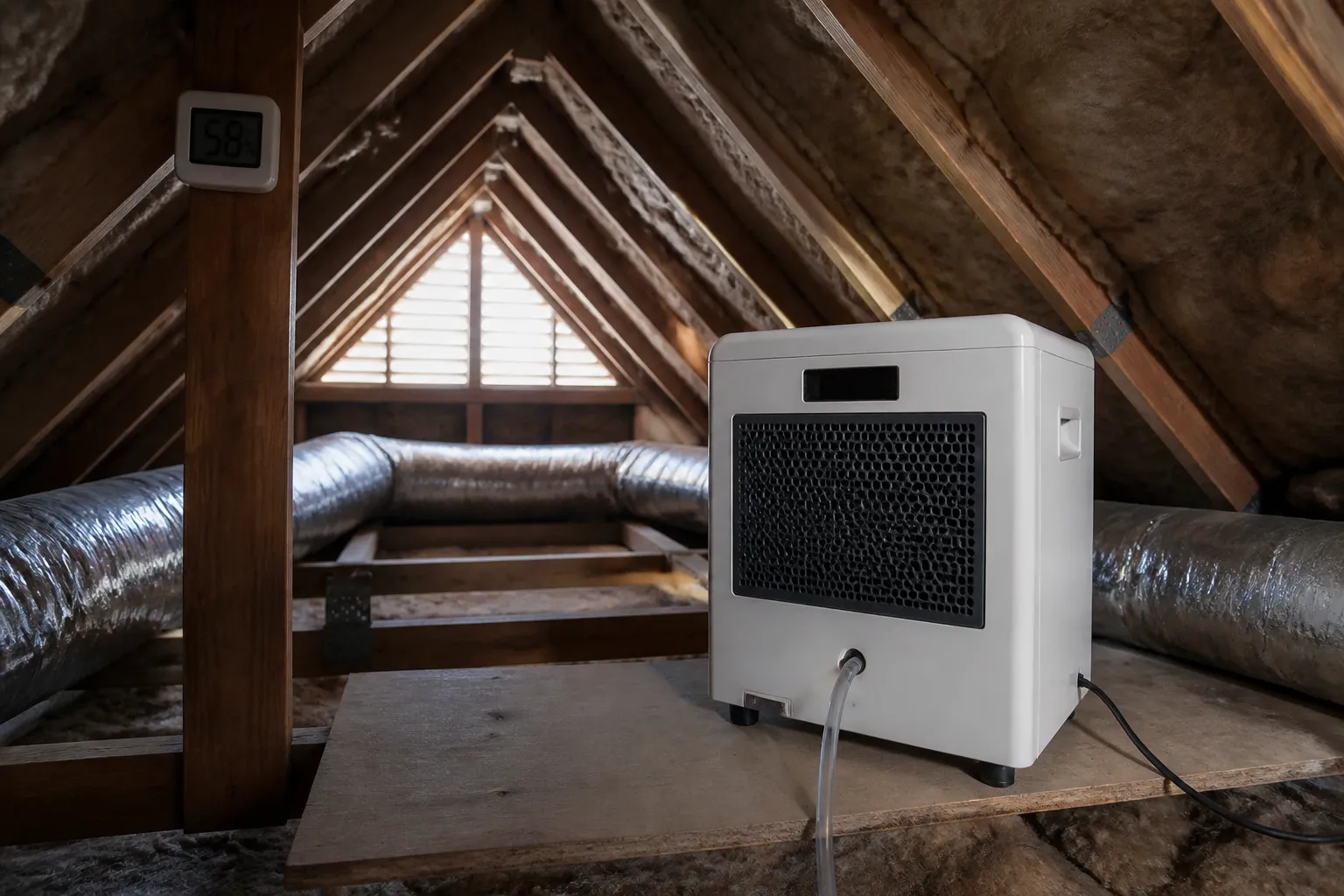
If air leaks or ventilation gaps already exist in your attic, adding a dehumidifier just gives you a band-aid running around the clock instead of a fix. But in cases where the moisture source is genuinely isolated and the structure itself is sound, a well-built unit can hold things over while you plan a more permanent approach.
Where it earns its keep
- A 70-pint capacity soaks up localized moisture surges without needing constant emptying — the built-in pump routes condensate out to a window or a foundation drain, so you’re not lugging buckets around in the middle of January.
- Operating noise stays low enough that it won’t turn into a background drone every time you’re up there, and power consumption is reasonable for short-term moisture control during seasonal shifts.
- Built for basements and crawl spaces, which means it’s got plenty of capacity for attic use too — undersizing is a mistake I’ve watched cost homeowners hundreds of dollars in wasted operating hours.
Where it falls short
- If uncontrolled air leaks or weak ventilation already exist in your attic, this thing becomes a permanent fixture — you’re managing the symptom, not the cause, and your utility bill will show it every month.
- You’ll need an outlet up there plus regular filter checks; if attic access is a struggle for you already, that upkeep is exactly the kind of task that quietly stops happening.
I almost recommended one to a client before realizing their entire soffit line was blocked with insulation—the dehumidifier would’ve masked a $400 ventilation fix with a $50-per-month electricity bill. Check out the ALORAIR Wi-Fi Crawl Space and Basement Dehumidifier if you’ve already ruled out ventilation and air sealing as your solution.
About This Article

Written by Dana Sorensen. Homeowner turned building-science obsessive. I help other homeowners understand attic insulation, ventilation, and air quality so they can stay comfortable year-round without overspending on energy bills. More about this site.
Scope and limits. Dana is a homeowner who studies building science, not an HVAC contractor or licensed tradesperson. Anything involving combustion appliances, gas lines, or electrical work belongs with a licensed contractor.
Verify this against a primary source
Specifics change, and your situation may differ from the one described here. These are the authorities worth checking directly:
- ENERGY STAR — recommended insulation R-values by climate zone
- U.S. Department of Energy — air sealing and insulation guidance
- EPA Indoor Air Quality — ventilation and indoor air quality standards