Search “attic cooling fix” online and you’ll run into two opposite camps: one tells you a powered attic fan is the quickest way to pull heat out and take pressure off your AC, the other insists passive ridge-and-soffit venting is all you need and that electric fans are a waste of money. The powered-fan camp is the one that’s wrong, and I watched exactly why play out last July at a home in Saint George, Utah. A homeowner named Mark was convinced his HVAC system simply couldn’t keep up — his upstairs bedrooms sat at 82°F no matter how hard the AC ran. He’d already swapped out his thermostat, added a return air duct, and was pricing a $6,000 system upgrade. Before I touched a single tool, I asked him one thing: did he have a powered attic fan up there? He lit up like I’d handed him a trophy. “Put it in myself two years ago. 1,200 CFM. Should be more than enough, right?” That pride was the tell — he’d unknowingly made his own problem worse. Once I got up into the attic with an infrared thermometer, the roof deck was reading 157°F in spots, and the ceiling drywall directly beneath the fan’s strongest pull sat at 94°F. That fan wasn’t cooling a thing — it was depressurizing his attic and hauling his already-cooled indoor air straight up through every recessed light, hatch, and ceiling penetration in the house. His AC wasn’t losing to undersized equipment; it was stuck re-cooling air it had already conditioned once. He didn’t need a bigger unit. He needed that fan gone. I have some version of this conversation on a regular basis — and if you’ve been weighing ridge vent vs powered fan for your own attic, you’re already asking the smarter question before you spend money on the wrong fix.
What Your Attic Is Actually Supposed To Do
Here’s the piece of building science most homeowners — and honestly, plenty of contractors — never quite grasp. Your attic isn’t meant to behave like conditioned living space. It’s supposed to act as a ventilated buffer zone between your roof and your ceiling. Attic ventilation isn’t there to make the space cool; it’s there to keep it close enough to outdoor temperature that it doesn’t turn into a 150°F radiant heater parked directly over your home.
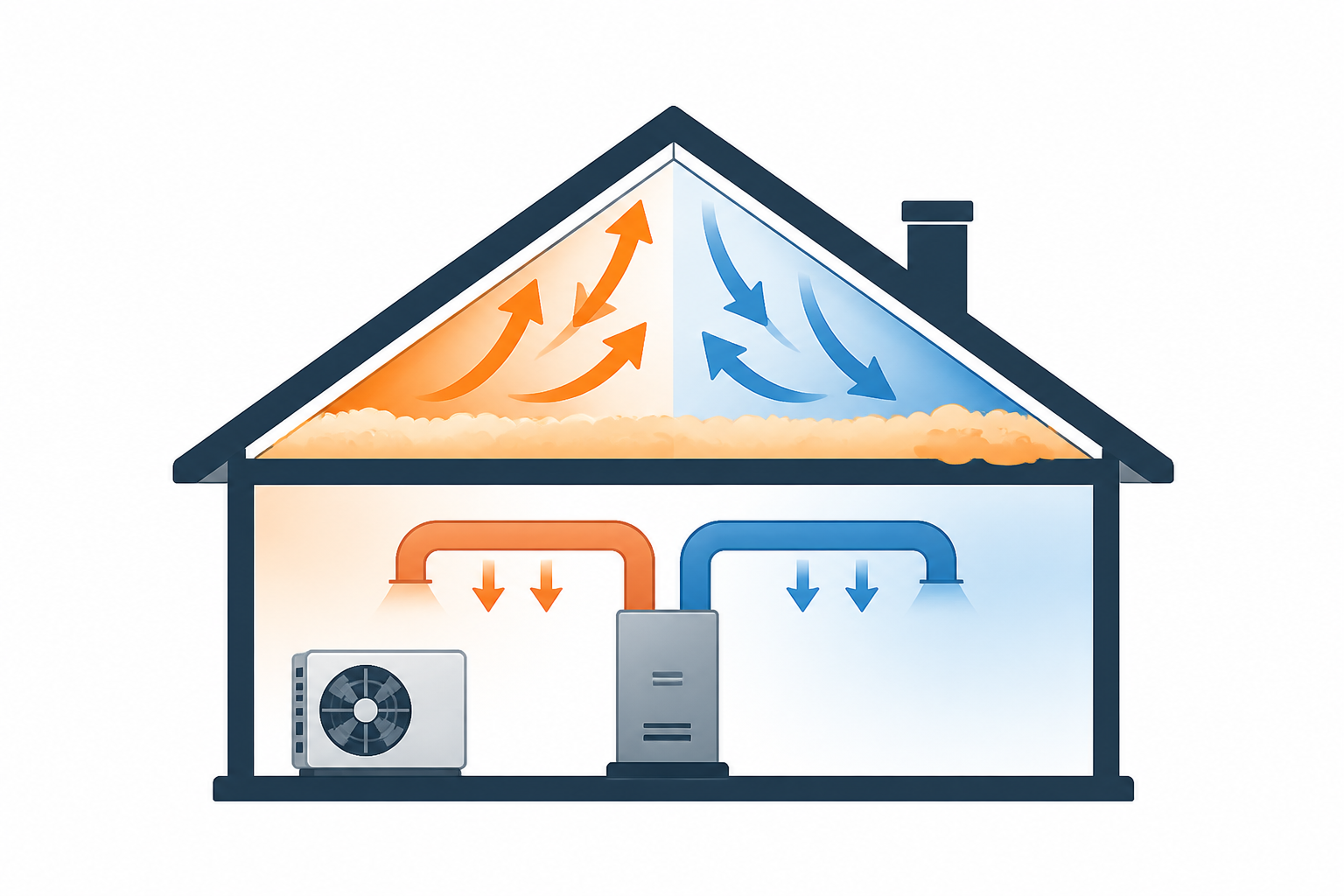
The mechanism behind passive ventilation is what’s called the stack effect. Warm air is lighter than cool air, so it rises. In an attic built the right way, that rising heat escapes through ridge vents at the peak of the roof, and the pull it creates draws cooler outdoor air in through soffit vents down at the eaves. No motor, no wiring, nothing that can burn out. It just keeps working — around the clock, every season, whether you’re home or not.
Building code sets the baseline here with what’s commonly known as the 1:150 rule: one square foot of net free vent area for every 150 square feet of attic floor. But once you have a balanced setup — intake at the soffits, exhaust at the ridge — most codes let that drop to a 1:300 ratio. That’s a major cut in the total vent area required, simply because balanced systems move air so much more efficiently than lopsided ones. International Residential Code Section R806 lays out the exact language if you want to dig into attic ventilation requirements by building code in your area.
This is exactly where powered attic fans fall apart, and the research backs it up plainly. The Florida Solar Energy Center studied these units and found they barely moved the needle on whole-house cooling costs — sometimes not at all. In a number of cases, they actually drove energy use up. The reason comes down to sheer volume: a 1,200 CFM fan needs far more airflow than passive venting was ever designed to handle. When soffit vents don’t have the net free area to feed that demand — and on most houses, they don’t — the fan pulls makeup air from wherever it can get it: recessed can lights, attic hatches, plumbing penetrations, wire chases. That means the 72°F air you paid to condition gets dragged out of your living space and dumped outside, while your AC scrambles to replace it with hot air and cool it all over again. You end up paying to run the fan and the AC harder, at the same time.
Things get genuinely dangerous when a gas water heater or furnace shares that attic space. Depressurize the attic enough and you can trigger backdrafting — combustion gases, carbon monoxide among them, getting pulled back into the appliance instead of venting outside the way they’re supposed to. I’ve flagged this exact issue on service calls more than once. It’s not a hypothetical risk.
How a Ridge Vent Made Mark’s Powered Fan Obsolete
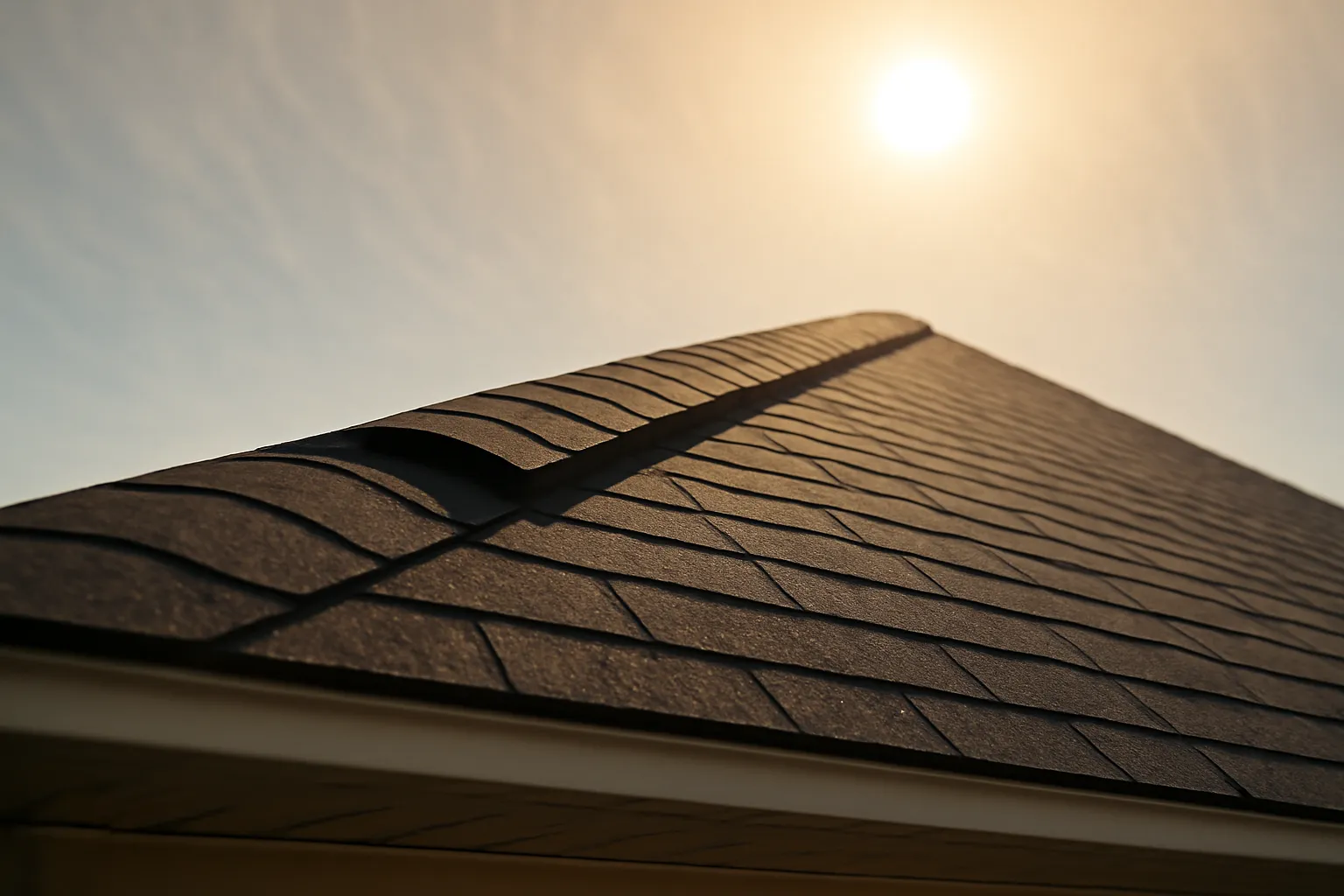
Once Mark agreed to shut that powered fan off for good, we still had the real issue to solve: getting proper attic ventilation in place. Skip that step and all you’ve done is trade one energy drain for another. A continuous ridge vent system is what actually did the trick here — it replaced the failing fan and worked with the attic’s natural convection instead of fighting against it.
Where Ridge Venting Delivers
- Runs around the clock without drawing a single watt — passive airflow alone was responsible for the 6-degree drop Mark saw upstairs once the powered fan was gone.
- Works alongside soffit vents to form one continuous intake-to-exhaust channel, actually flushing heat and moisture out instead of just shuffling hot air around after midnight.
- Holds up through hard rain and snow, since a properly built strip vent design keeps weather out while still moving air year-round.
Where Ridge Venting Falls Short
- Depends entirely on having enough soffit intake — if your eaves are blocked or lack proper venting, a ridge vent by itself won’t solve a thing.
- Requires pulling old shingles and sealing the job correctly, which is a genuine roofing project if you’re not comfortable working on the roof or would rather hire it out.
I’ll admit, I was halfway through Mark’s attic before I realized his soffit vents were clogged with insulation—almost a showstopper. But once we cleared the intake and installed the Owens Corning VentSure 4ft. Strip Heat & Moisture Ridge Vent (Carton of 10), his cooling bills dropped 18% and those bedrooms stayed at 76°F.
About This Article

Written by Dana Sorensen. Homeowner turned building-science obsessive. I help other homeowners understand attic insulation, ventilation, and air quality so they can stay comfortable year-round without overspending on energy bills. More about this site.
Scope and limits. Dana is a homeowner who studies building science, not an HVAC contractor or licensed tradesperson. Anything involving combustion appliances, gas lines, or electrical work belongs with a licensed contractor.
Verify this against a primary source
Specifics change, and your situation may differ from the one described here. These are the authorities worth checking directly:
- ENERGY STAR — recommended insulation R-values by climate zone
- U.S. Department of Energy — air sealing and insulation guidance
- EPA Indoor Air Quality — ventilation and indoor air quality standards