Last month I got a call from a homeowner in a 1970s split-level with no central air and no ductwork to speak of. She’d bought a “whole house dehumidifier” online — 50 pints per day, good reviews, seemed like the right size for her 2,200 square feet. She’d been running it in her basement for three weeks. The basement was dry. Upstairs, the master bedroom still had condensation on the windows and that wet-towel smell that means 65% humidity or worse.
“It’s not working,” she said. “Do I need to buy another one?”
The answer wasn’t another dehumidifier. The answer was that she’d been sold a solution designed for a house that didn’t match hers — and she wasn’t alone. Every week I talk to homeowners with mini-splits, hydronic heat, window units, or old radiator systems asking the same question: “Is one whole house dehumidifier enough for my house?” They’re reading sizing charts online that silently assume a central forced-air HVAC system is doing the air distribution work. Take that system away, and the entire math changes.
A house without ductwork is a humidity problem that looks different from the inside. In this post, I’m going to show you what actually works for a whole house dehumidifier for a house without ductwork, how to size it right, and why the solution most people don’t know exists is probably the answer you’re looking for.
Understanding the Problem: Why Square Footage Stops Being the Governing Number
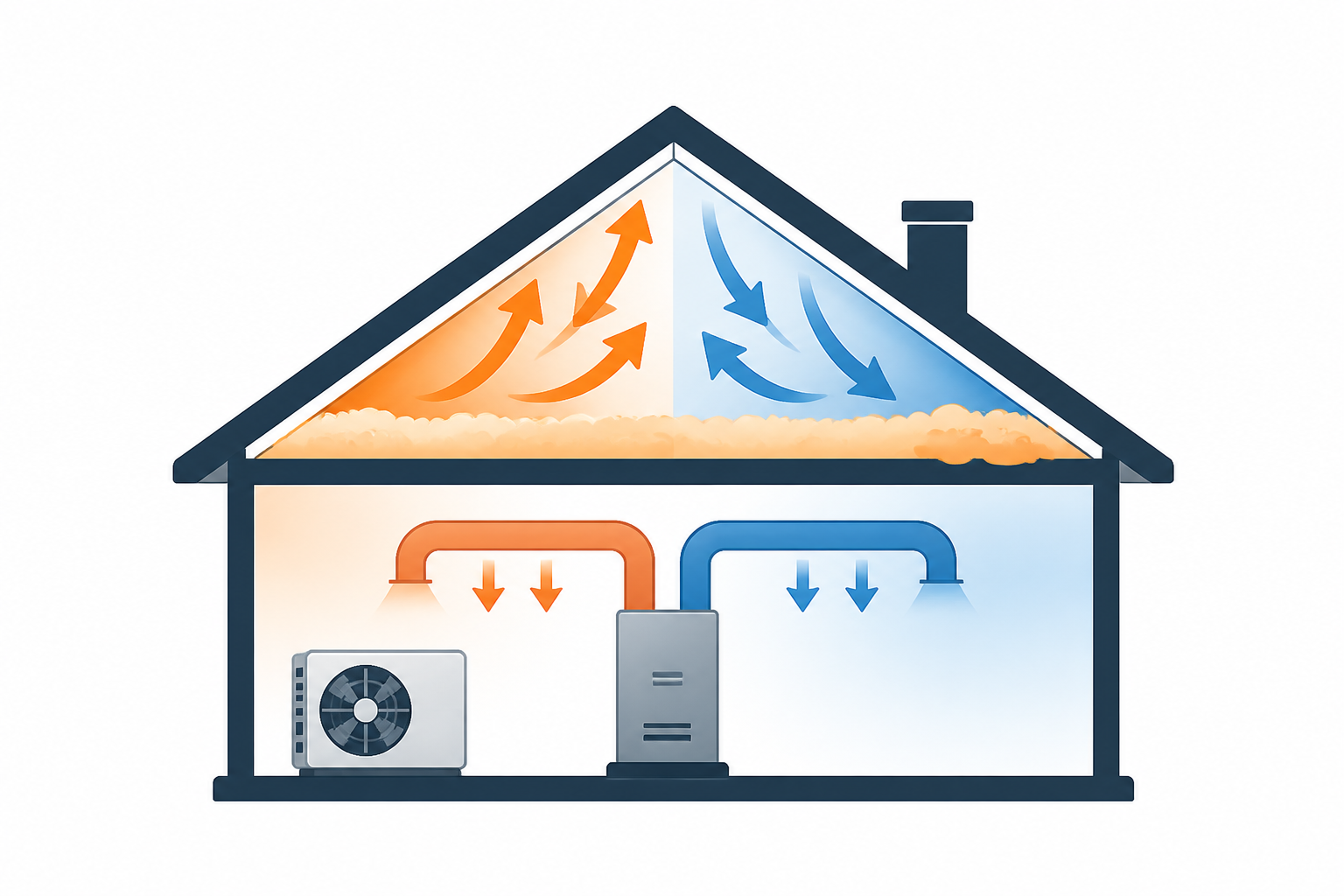
Here’s the core misunderstanding that trips up most homeowners: dehumidifier sizing charts online give you a number in square feet — “50-pint for up to 1,500 sq ft” — and those charts are all written for houses with central air. In a ducted house, an air handler with a multi-ton blower is continuously mixing air from every room and running it across the dehumidifier’s evaporator coil. The ductwork does the heavy lifting of air distribution. You could put the unit in one closet and it still treats the whole house because the blower forces air to flow.
Without ductwork, that’s gone. A dehumidifier can only treat the air that physically reaches it through natural air movement — and natural air movement is slow, stratified, and stops at closed doors. So the real question isn’t “Is one unit enough for 2,200 square feet?” It’s “Can air from all 2,200 square feet actually get to the unit and back?”
Answer that question first, and the sizing follows.
The Three Factors That Actually Decide If One Unit Will Work
1. Floor plan openness. An open-concept 2,200 square foot single story with wide cased openings is one air zone. A 2,200 square foot house chopped into eight rooms with doors that stay closed is eight separate air zones. One dehumidifier will dry the hallway and nothing else.
2. Number of floors. Humidity stratifies. Hot, humid air rises — and in a two-story house or a house over a basement, you’ve got natural stack effect separating your humidity problem into layers. Upper floors will always read higher humidity than the basement, even if you run a dehumidifier downstairs all day. That’s not the unit failing. That’s building science.
3. Where the moisture is actually coming from. This is the one nobody asks, and it’s usually the most important. A damp basement or crawl space is a moisture source — it’s feeding the entire house with humid air. Trying to dry out the main floor with a dehumidifier while ignoring the basement is like bailing water out of a boat while a hole stays open in the hull. Often the real answer is a separate unit treating the source directly.
Dehumidifier Sizing in Pints Per Day — And the Rating Change That Confuses Everyone
Dehumidifier capacity is stated in pints of water removed per day. In 2019, AHAM (Association of Home Appliance Manufacturers) revised the test conditions from 80°F/60% RH to 65°F/60% RH — a more realistic home condition. But here’s what happened: the exact same machine tested under the new standard carries a smaller number.
A modern “50-pint” dehumidifier is roughly equivalent to what used to be sold as a 70-pint unit. A modern 70-pint is roughly the old 95-pint. Most sizing charts online haven’t updated, and most homeowners comparing an old blog post to a new Amazon box get this wrong constantly.
When you’re shopping today, use the new AHAM numbers. If you see both numbers on a box, trust the newer one.
Practical Sizing for 2,200 Square Feet With No Ductwork
- Open, single story, moderately damp: One 70-pint (current AHAM standard) unit, centrally located. Usually enough.
- Open, single story, very damp (musty smell, window condensation, 65%+ RH readings): Step up to a 90-to-100-pint class unit rather than adding a second small one. Capacity is cheaper per pint as you go up, and one larger unit will modulate better than two struggling smaller ones.
- Two story, or closed floor plan: One unit will not do it on its own. Either add a short duct kit (which I’ll explain below) or plan on two units — one per zone.
- Basement or crawl space in the picture: Treat that space separately. It’s almost always the moisture source.
A rough starting point is 60-70 pints for 2,200 square feet under average conditions. Then adjust upward for dampness, occupancy, floor count, and closed doors. Those adjustments matter more than the base number.
The Solution: What I Recommend for a Whole House Dehumidifier for a House Without Ductwork
There’s a solution most people don’t know exists, and it’s the answer to the original question: a standalone ducted dehumidifier without HVAC system integration.
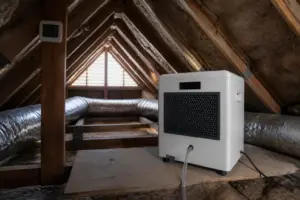
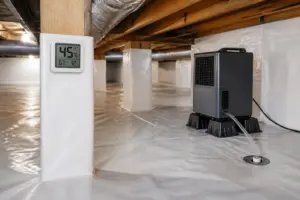
Units like the Waykar 125 Pints Crawl Space Dehumidifier with Dual Duct Kit can be installed free-standing in a basement, utility room, or closet with their own short supply and return duct runs. You’re not trying to splice into central air. You’re building a miniature air distribution system that serves only the dehumidifier. A single 6-inch or 8-inch supply run to the far end of the house, plus a return grille near the unit, converts a “one room” dehumidifier into something that actually treats 2,200 square feet.
This is the move for a non-ducted house, and it’s worth understanding why.
Why This Approach Works
- High capacity without ductwork dependency: The Waykar 125-pint unit pulls moisture at scale — this is a commercial-grade machine, not a consumer portable stuck in a corner. 125 pints per day (modern AHAM rating) is serious capacity for a moderately damp house or a very damp 2,200 sq ft space.
- Included dual duct kit: The box comes with supply and return ducting options. You can run a short duct to pull air from a distant room or the other side of the house, then return it after it’s been dried. This solves the “air has to physically reach the unit” problem without requiring you to retrofit a central HVAC system.
- Drainage by pump or gravity: Built-in condensate pump means you don’t need to find a perfect slope to a drain. Drain it into a floor drain, sink, or run the pump line out a rim joist — you’re not dealing with emptying buckets twice a day.
- Remote control and automatic setpoint: Set it to 50% RH and it cycles on and off as needed. You’re not manually managing it.
- 5-year coverage: This is a workhorse unit, and the warranty backs that up. It’s built for basement and crawl space duty where conditions are harsh.
At $599.99, this is a genuine whole-house dehumidifier for a house without ductwork. It’s not a portable unit at 2x the price. It’s not two small units that won’t coordinate. It’s one substantial machine with the infrastructure to actually serve your house.
One honest limitation: a dehumidifier is a refrigeration machine that rejects its heat back into the room. In a house with central AC, that heat gets picked up and removed. In a house with no cooling system, it doesn’t. Expect the space to run 2-5°F warmer while the unit is operating. In a humid climate with no AC, that’s a genuine trade-off — you’ll be drier and slightly warmer. Some people find 78°F at 50% RH more comfortable than 75°F at 70% RH, and that’s a real and defensible reason to run one. But don’t let anyone claim it’s free.
Step-by-Step: How to Install and Set Up a Standalone Ducted Dehumidifier
Location and Placement
Put the unit in the lowest point of your house — usually the basement or utility room. Humid air is denser and settles. If you’re running ductwork to pull air from upstairs, the unit downstairs becomes a gravity assist. Never put a dehumidifier in an attic or upper floor if you can help it.
Make sure there’s clearance around it. The unit needs breathing room on the return side. Don’t shove it in a tight corner.
Ductwork Setup (If Using the Duct Kit)
The Waykar comes with dual duct fittings. Here’s the basic setup:
- Run one 6-inch or 8-inch duct from the supply outlet to the area you want to dehumidify — usually the far end of the house or an upper floor. This pulls air into the machine.
- Leave the return side open to the room where the unit sits, or run a return duct if you want to pull air from a distant return.
- Use rigid or reinforced ducting that won’t kink. Undersized or kinked ducts increase static pressure and reduce airflow — the unit has to work harder and runs longer.
- Keep duct runs short. Every 10 feet adds friction. A 20-foot supply run is the practical limit.
Drainage Setup (This Matters Most)
Do this right the first time. A dehumidifier running 24/7 can produce 100+ pints of water per day. That’s 50 gallons. Manual bucket emptying is how machines end up unplugged and abandoned.
- Gravity drain: If there’s a floor drain, utility sink, or sump pit in the room where the unit sits, use gravity. Run the condensate line from the unit’s drain outlet to the drain, with continuous slope. No kinks, no low spots where water pools.
- Condensate pump: The Waykar includes a pump option. Use it if there’s no convenient gravity drain. Run the pump line out a rim joist, to a floor drain, or into a sump pit. Don’t just dump it on the floor.
- Pan protection: If the unit is in a finished space, put it in a drain pan or a shallow containment tray. Condensate line kinks happen. The pan buys you time to notice.
Setpoint and Runtime
Target 45-55% relative humidity. Below 45% you’re spending money to fight the outdoor air for no comfort gain. In winter, over-drying can cause wood shrinkage and static electricity problems. Above 55% and you’re not solving the humidity problem.
A correctly sized unit should cycle — run for a while, then stop when the space reaches your setpoint. If it runs 24/7 at your target humidity, it’s undersized or you have an unaddressed moisture source (see below).
Use the remote control to set it and leave it. The machine handles the rest.
If You’re Not Ducting It: How to Move the Air Anyway
Not everyone wants to run ductwork. If you’re placing a dehumidifier in a non-ducted house without the duct kit, here’s how to maximize the air movement you do get:
- Place it centrally and low. Dead center of the main living area, on the ground or lowest shelf. Humidity stratifies upward, so a low location catches the densest air first.
- Undercut interior doors by 3/4 inch. Closed doors block air flow. If you can’t stand undercuts, install transfer grilles in doors — a 4-inch x 12-inch grille does real work.
- Run ceiling fans on low continuously. Not high speed in bursts — slow, constant circulation is quieter and mixes air better. Fans are cheap electricity compared to a dehumidifier running longer than it needs to.
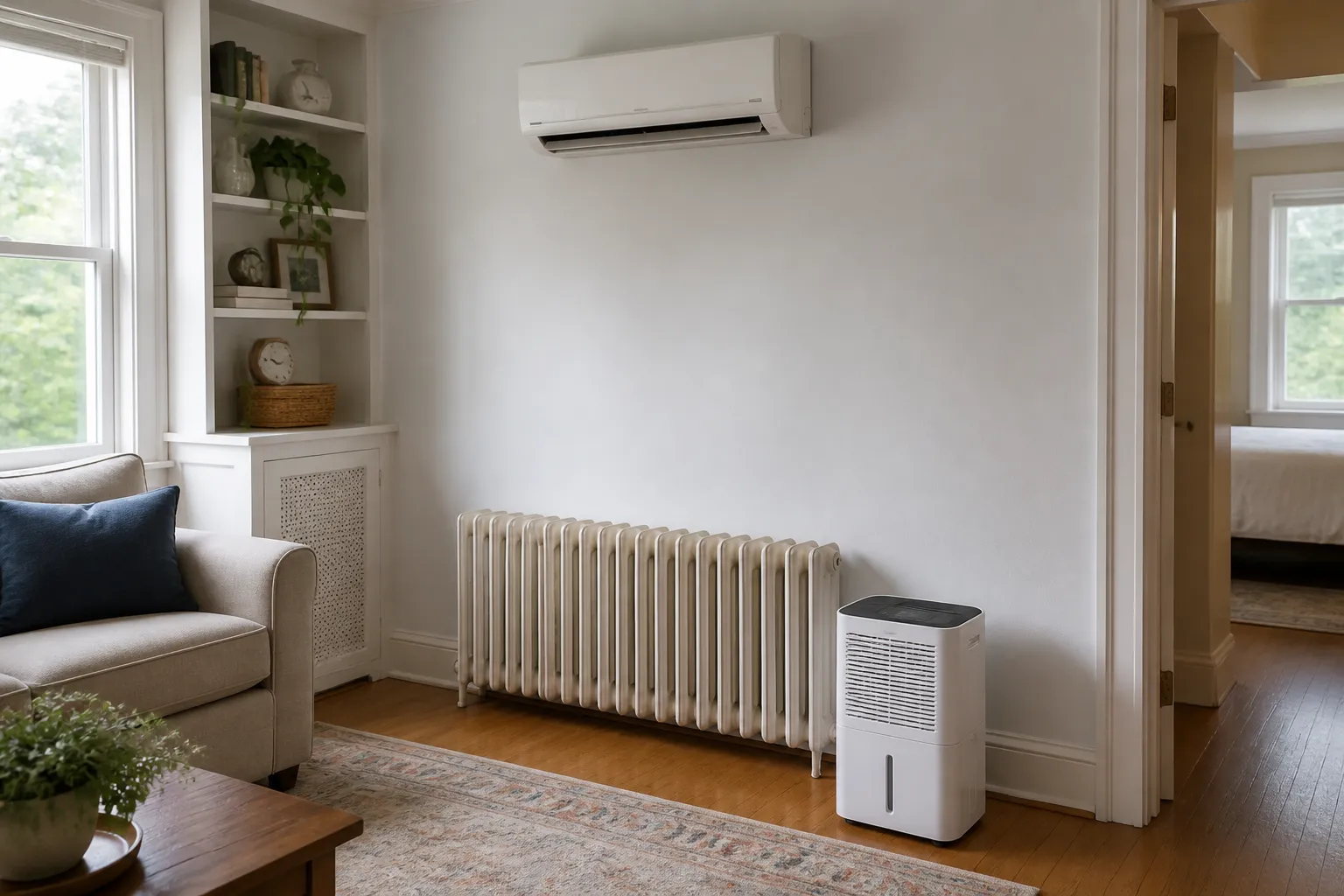
- If you have mini-splits, run them in fan-only mode. Most homeowners never touch that setting. A mini-split on fan-only mode will recirculate your air without heating or cooling, which helps move humid air to the dehumidifier. Low speed is all you need.
These tactics won’t replace ductwork, but they buy you real performance if you’re running a dehumidifier in a non-ducted space.
Common Mistakes to Avoid
1. Buying a Unit Without Addressing the Moisture Source
If your grading slopes toward the foundation, your downspouts dump six inches from the basement wall, your crawl space has no vapor barrier over the dirt, or you have an unvented bath fan running into the attic, a dehumidifier is fighting a losing battle. Ten minutes of walking the house beats a month of running equipment. Fix the source first. Then size the dehumidifier to handle what’s left.
2. Using Two Undersized Units Instead of One Right-Sized Unit
I see this constantly. Someone buys two 50-pint dehumidifiers because they’ve read that’s the “rating for 2,200 sq ft,” then runs both all day and they still can’t get below 58% humidity. A single 90-to-100-pint unit would have solved it. Capacity is cheaper per pint as you go up. One good machine beats two struggling ones, and it costs less to run.
3. Placing the Unit Too Far From the Area You Need Dried
Without ductwork, air flow is limited. Putting a dehumidifier in the basement closet and expecting the upstairs bedrooms to stay dry is wishful thinking. Either place it centrally, use the duct kit to pull air from distant areas, or plan on a second unit.
4. Not Setting Up Drainage Right
Bucket emptying leads directly to machines unplugged and abandoned in closets. A floor drain or condensate pump is a one-time 30-minute investment that means the unit actually runs. Do it.
5. Oversizing Without a Moisture Source Problem
If your house is already in the 50-55% RH range and has no visible damp or condensation, a monster 125-pint unit may be overkill. It’ll cycle quickly and cost more to run than needed. A 70-pint will probably do. Start with what makes sense for your baseline humidity and dampness level, then adjust if you’re not hitting your target.
When to Call a Pro vs DIY
DIY territory: Placement, setpoint configuration, and basic drainage setup. If you can plug something in and run a hose, you can handle this.
Call a pro if: You want to run more than 20 feet of supply ductwork, you need to tie the drainage line into a condensate line that serves other equipment, you have a basement with water intrusion or structural issues (a dehumidifier alone won’t fix that), or you want to integrate the unit with a mini-split or other mechanical system for coordinated air flow. A local HVAC tech can spec the ductwork, size it correctly, and make sure it integrates well with your existing systems.
Budget $300-500 if you need professional duct work or tie-in. It’s worth it to get the system dialed in correctly the first time.
Find the Source Before Buying Anything
Before you order a dehumidifier, spend an afternoon doing this walk-through:
- Check your grading. Does the ground slope toward the house or away from it?
- Look at downspouts. Are they dumping water at the foundation?
- Go in the basement or crawl space. Is there standing water, efflorescence (white mineral stains), or that musty smell? Is the dirt covered with a vapor barrier?
- Find your bath fans. Do they vent outside, or back into the attic?
- Check your dryer. Is it venting outside or into the house?
- Walk the perimeter. Any obvious leaks, cracks, or water stains?
Each of those problems generates more moisture than a dehumidifier can economically remove. Fix them first. Then you’ll know what size dehumidifier actually makes sense.
Sizing a Dehumidifier for a Mini-Split House: A Specific Example
Let me walk through a real scenario that comes up often — a 2,200 sq ft house with mini-split heat and no central air or ductwork.
You get a humidity reading of 62% RH in winter and early spring. No active leaks, but the basement is cool and damp and your upper bedrooms feel humid. Your grading and downspouts are okay.
Here’s what I’d recommend:
- Start with a 70-pint dehumidifier for the main living space, placed centrally, undercutting interior doors to improve air circulation. Run your mini-split in fan-only mode on low speed while the dehumidifier operates. That coordinate air flow without heating/cooling.
- Install the condensate pump drain to a floor drain or sump pit — don’t fuss with buckets.
- Set the target to 50% RH and let it cycle.
- If the main floor reaches 50% but the basement is still 60%+, add a second, smaller dehumidifier in the basement — a 50-pint portable unit in the corner of the finished area. Or, if the basement is truly the moisture source (dirt floors, no vapor barrier), treat just the basement with its own unit.
That’s a layered approach that treats the real problem without oversizing or undersizing either zone.
The Bottom Line: Whole House Dehumidifier for a House Without Ductwork
The mistake homeowners make is treating “whole house dehumidifier for a house without ductwork” as if it should work the same as one designed for central air. It doesn’t. The ductwork does half the work, and without it, you have to solve air distribution differently.
For most people, that means one of two approaches:
Approach 1: Ductwork with one larger unit. If you’re willing to run 20-30 feet of ductwork, the Waykar 125 Pints Crawl Space Dehumidifier becomes a genuine whole-house solution. One unit, one location, professional-grade capacity, and it actually reaches all 2,200 square feet because the ductwork brings the air to it. $599.99 for a unit that will run cleanly for years.
Approach 2: Two smaller units in separate zones. If your house is multistory or chopped into closed rooms, one unit won’t work no matter the size. Two 70-pint units — one main floor, one basement or upper floor — will each treat their zone. More equipment cost, but sometimes it’s the only way.
Start by walking your house and asking: Can air from all my damp spaces physically reach a central dehumidifier? If yes, go with one right-sized unit. If no, ductwork or zone approach is the answer.
Don’t let a sizing chart written for a ducted house drive your decision. Your house works differently. Treat it accordingly.
Ready to take action? If you’re committed to solving humidity in a non-ducted house, start here: Get a humidity meter ($20), take readings in every room, identify which areas are worst, and use that data to decide between one unit with ductwork or a zone approach. Then specify equipment to match what you’ve learned about your actual house, not the square footage on a generic chart. If you want the unit I trust most for this job, the Waykar 125-pint with dual duct kit is built for exactly this scenario.
About This Article

Written by Dana Sorensen. Homeowner turned building-science obsessive. I help other homeowners understand attic insulation, ventilation, and air quality so they can stay comfortable year-round without overspending on energy bills. More about this site.
Scope and limits. Dana is a homeowner who studies building science, not an HVAC contractor or licensed tradesperson. Anything involving combustion appliances, gas lines, or electrical work belongs with a licensed contractor.
Verify this against a primary source
Specifics change, and your situation may differ from the one described here. These are the authorities worth checking directly:
- ENERGY STAR — recommended insulation R-values by climate zone
- U.S. Department of Energy — air sealing and insulation guidance
- EPA Indoor Air Quality — ventilation and indoor air quality standards