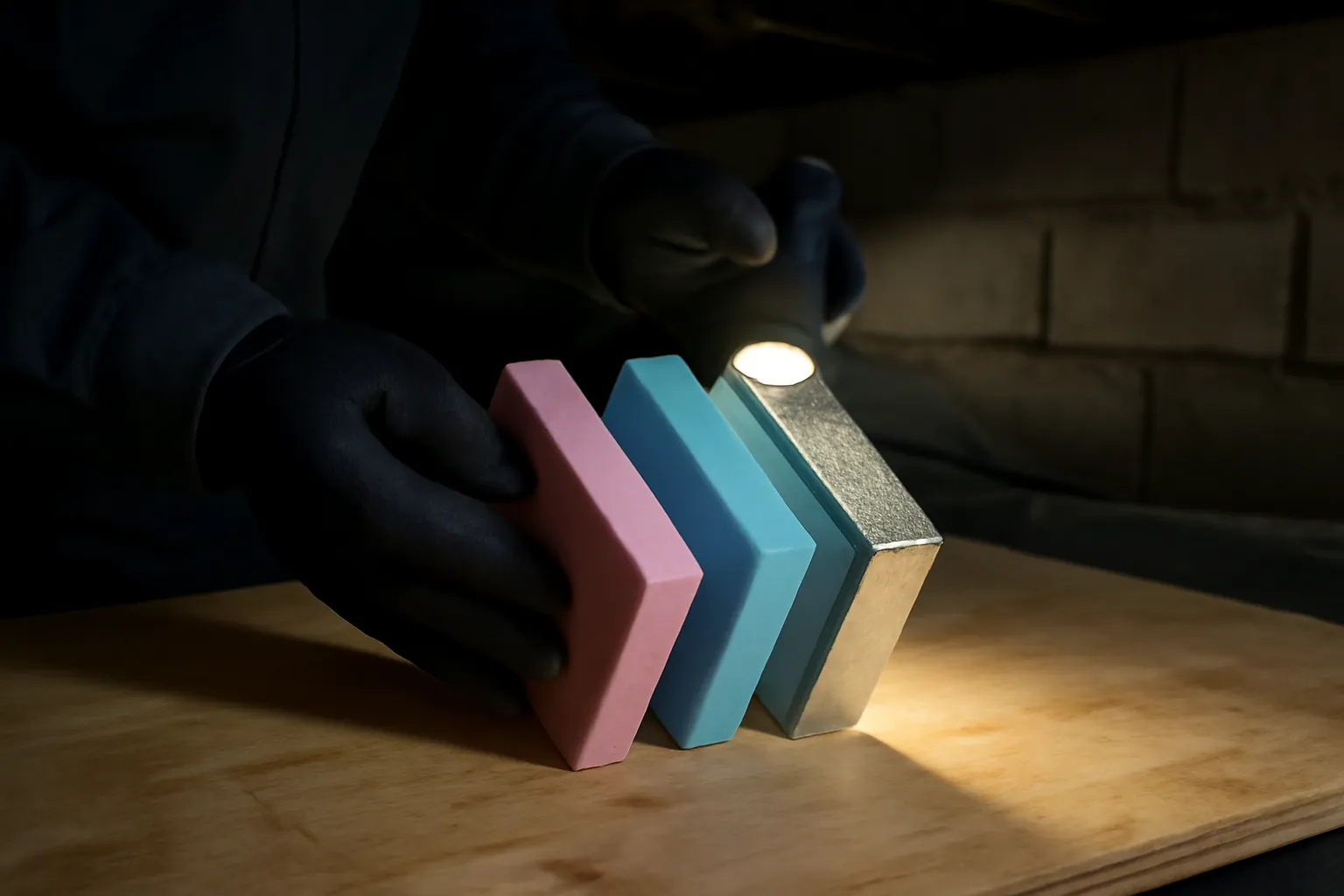
My thermal camera flags a nine-degree cold streak crawling straight up the foam board lining a freshly-framed basement wall in northern Utah — and that’s the reading that told me the homeowner standing next to me had grabbed exactly the wrong sheet off the rack. Twelve panels of silver, foil-faced polyiso were already screwed to his studs, bought because the label promised the highest R-value per inch of anything on the shelf. Bigger number, better insulation — that was his thinking. Before he picked up a utility knife to start cutting panels to fit, I had to explain why that math was about to work against him. Nailing down rigid foam board insulation where to use each type isn’t something you can eyeball from the lumber aisle; three boards, three colors, nearly identical thickness, and every single one claiming to be the answer.
That silver polyiso in his hands sheds somewhere around 25–30% of its labeled R-value once temperatures drop — and a below-grade wall in a Utah basement lives in exactly that kind of cold. The blue or pink sheet he’d passed over on his way to the register would have actually served him better. None of this makes him careless; the packaging simply never volunteers its own weak spots. Across fifteen years of home performance assessments and HVAC service calls, I’ve torn out mis-specified foam more times than I care to tally. White board tucked below a slab where XPS should have gone. Polyiso nailed to a rim joist, taking freeze-thaw cycles it was never built for. EPS spec’d into a cathedral ceiling where every fraction of an R-value point actually counts. None of those callbacks were cheap — replacement material, inflated utility bills, or usually both.
What follows breaks down what actually separates EPS, XPS, and polyiso — not the glossy marketing claims, but the building science underneath them — and pins down exactly where each one earns its keep in a house.
Why the Type of Foam Board You Choose Actually Changes the Outcome
Most people treat rigid foam as one product with three price tags. It’s an easy mistake — all three cut with the same tools, stack in the same familiar 1-inch and 2-inch thicknesses, and look close enough at a glance. But underneath that similarity, the chemistry, the cell structure, and how each one handles moisture couldn’t be more different. Get the choice wrong here and it’s nothing like picking the wrong paint sheen — you’re looking at a wall assembly that holds onto moisture, insulation that quietly underperforms by 30% exactly when you need it most, or a product that breaks down over time because of what adhesive it’s touching.
EPS — Expanded Polystyrene (The White Bead Board)
EPS is that white, pebbly-textured board — chemically the same stuff as a disposable coffee cup. It’s the cheapest of the three, landing at R-3.6 to R-4.2 per inch depending on how dense it’s manufactured. Here’s the detail people skip past: EPS lets moisture move through it. It’ll soak up some water over time, but it also releases it again as conditions shift. That drying ability actually works in your favor in the right spot — above-grade exterior foundation walls, for instance. Underneath a slab it performs fine too, since it’s sandwiched away from bulk water on either side. It’s also the gentlest option environmentally in terms of the blowing agents used to make it. Where it falls short: anywhere moisture sits around long-term, or where you need serious compressive strength out of a thin section.
XPS — Extruded Polystyrene (The Blue or Pink Board)
XPS comes off an extrusion line with a closed-cell structure — every cell sealed off from the next — which cuts moisture absorption way down. It holds a steady R-5.0 per inch across a wide temperature swing and brings serious compressive strength to the table, typically 25 PSI at 10% deformation for the standard residential grade. That combination is exactly why it belongs below grade: basement walls, under-slab insulation where moisture control is non-negotiable, and rim joist work where foundation, sill plate, and floor system all meet in a spot that stays vulnerable to damp. The sealed cell structure also functions as a built-in vapor retarder — at 2 inches, XPS typically clocks in near 1.0 perm, which actually matters when you’re managing moisture in a basement assembly.
Polyiso — Polyisocyanurate (The Silver Foil-Faced Board)
Polyiso sits at the top of the performance chart, rated R-6.0 to R-6.5 per inch at room temperature — the highest labeled R-value per inch of any rigid foam on the market. The foil facer doubles as a radiant barrier when it faces an air gap. But here’s the piece of building science that sent my Utah homeowner back to the supply house: polyiso loses ground fast once temperatures drop. Both lab testing and field monitoring back this up consistently — at 25°F, effective performance falls to something closer to R-4.5 per inch, a 25–30% dip below what’s printed on the label. Where the assembly stays reasonably warm — a cold-climate above-grade wall or roof, for example — polyiso genuinely shines. On an attic roof deck, a cathedral ceiling, or as continuous exterior insulation above grade, it’s worth the extra cost. Install it below grade, or anywhere it’ll routinely sit below 40°F, and you’ve paid a premium for performance that simply won’t show up when conditions get toughest.
Worth flagging here too: those foam board insulation R-value comparison figures printed on the packaging are all tested at a 75°F mean temperature. That number rarely matches the real conditions most homeowners are trying to insulate against. Before you buy on label R-value alone, think through where in your thermal envelope that insulation layer will actually sit.
The Blue Sheet That Finally Cleared Up My Basement Foam Confusion
Below-grade work — basements, rim joists — is exactly where moisture resistance stops being optional, and it’s exactly where most DIYers pull the wrong sheet off the shelf. Blue XPS foam is built for these conditions specifically, holding up against moisture far better than expanded polystyrene can, but only if you actually reach for it instead of settling for the cheaper white or pink option sitting next to it.
Where it earns its keep
- The sealed cell structure blocks water out entirely — R-value holds steady even if the basement turns damp or sees a little seepage
- Foil facing built into the boards handles vapor-barrier duty on its own, saving you from stacking extra material or tape into a cramped rim joist cavity
- Slices cleanly with just a utility knife, and going with 2-inch stock gets you a solid R-10 or so without chewing up too much of your foundation wall depth
Where it falls short
- Price runs meaningfully higher than white bead board — figure roughly 2–3 times more per sheet, which adds up fast on bigger jobs
- Use it somewhere dry and above-grade, like attic rafters, and you’re paying extra for moisture protection you never actually needed
I almost talked that Utah homeowner into returning his silver board and starting over, which felt wasteful until I ran the numbers on what mold remediation costs down the road. If basement or below-grade insulation is in your plans, grab the LuckyFoam Blue 4 Pack 15x12x2 inch Polystyrene XPS Foam Board and stop second-guessing yourself in the lumber aisle.

About This Article

Written by Dana Sorensen. Homeowner turned building-science obsessive. I help other homeowners understand attic insulation, ventilation, and air quality so they can stay comfortable year-round without overspending on energy bills. More about this site.
Scope and limits. Dana is a homeowner who studies building science, not an HVAC contractor or licensed tradesperson. Anything involving combustion appliances, gas lines, or electrical work belongs with a licensed contractor.
Verify this against a primary source
Specifics change, and your situation may differ from the one described here. These are the authorities worth checking directly:
- ENERGY STAR — recommended insulation R-values by climate zone
- U.S. Department of Energy — air sealing and insulation guidance
- EPA Indoor Air Quality — ventilation and indoor air quality standards