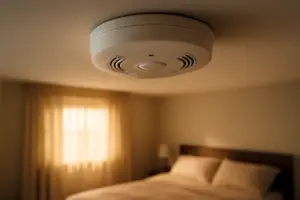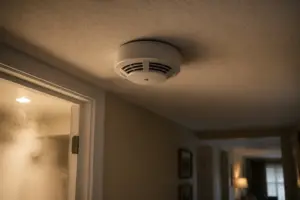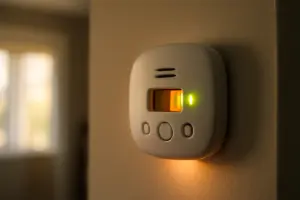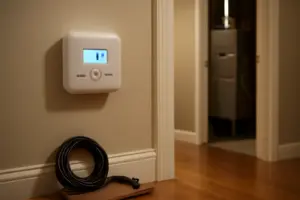
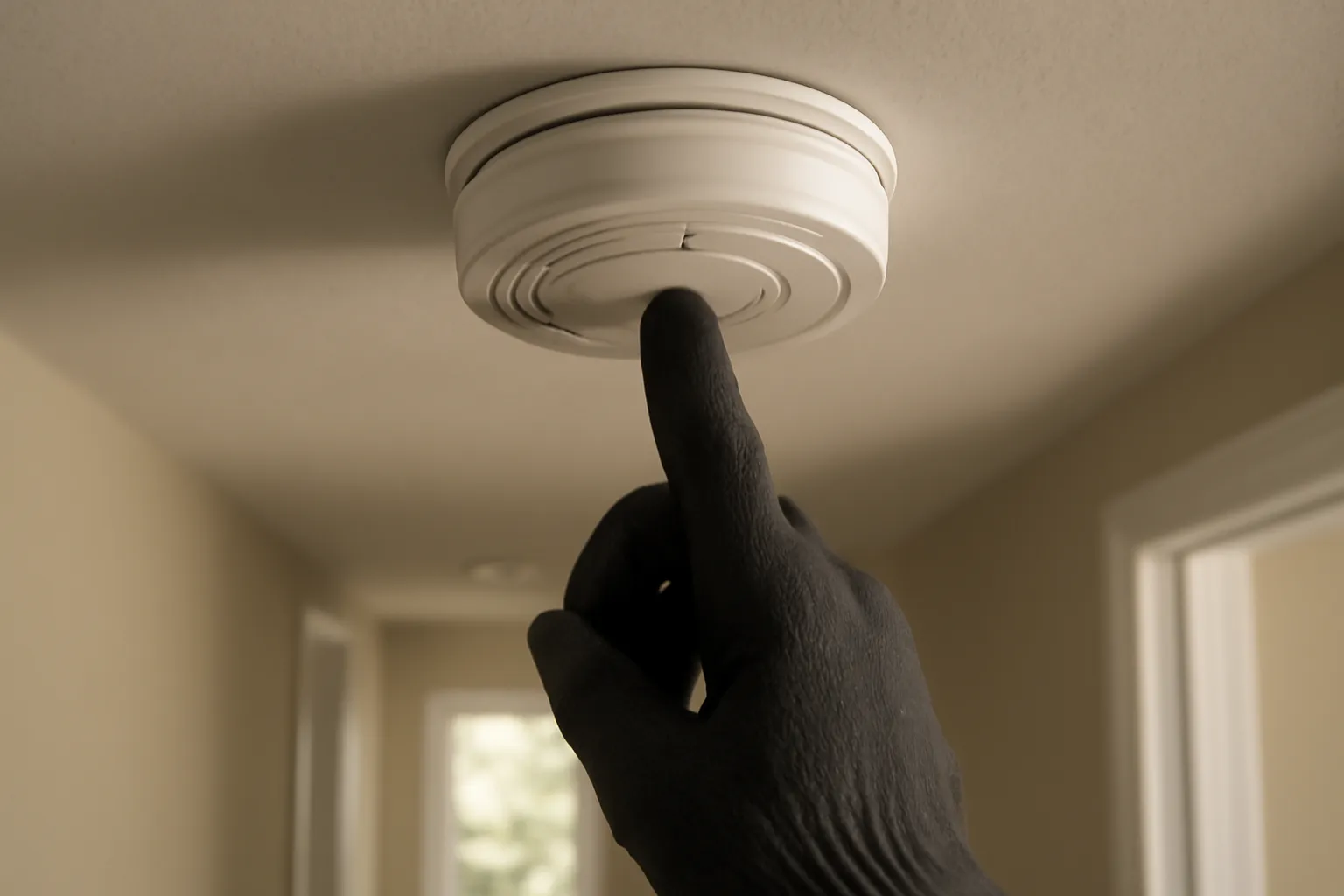
Forty percent output — that’s what my handheld light meter registered when I aimed it into the optical chamber of a hallway smoke detector I’d just pulled down off its bracket. I was at a house in the suburbs on what should’ve been a routine ductwork check, up in the attic, when the homeowner mentioned a chirp she’d been hearing for weeks and figured was a dying battery. I climbed down to take a look. Flipped the unit over. The manufacture stamp on the back read 2009. It was 2023. That detector was four years past its rated life. She pressed the test button while I held it in my hand — full beep, green light, everything about it screamed “working fine.” But a test button tells you nothing about what’s happening at the sensor level. Inside that photoelectric chamber, the LED had been quietly losing brightness for over a decade, the optical cavity had picked up years of dust and cooking residue, and the photodiode on the receiving end had grown dull to the light it was supposed to catch. That chirp wasn’t a battery warning at all — it was the unit telling her it had reached end-of-life. When I explained that a functioning test button says nothing about a functioning sensor, she got quiet fast. I’ve had some version of that conversation more times than I can count. Here’s the number that should bother you: roughly 30% of the smoke detectors mounted in homes across the country right now are past their expiration. They pass their tests. Their batteries are fine. And they may stay silent well past the point where a fire has already gotten out of hand. Figuring out when to replace smoke and CO detectors expiration isn’t a box you check once and forget — it’s one of the conversations I have most often, and most urgently, with the homeowners I work with.
The Real Issue: Why a “Passing” Smoke Detector Might Not Be Protecting You
Let’s dig into the mechanics for a minute, because once you see what’s physically happening inside one of these units, the urgency stops feeling abstract and starts feeling personal.
None of these devices sit idle. Every single one is doing something around the clock — sustaining a faint radioactive current, cycling an LED through a dark chamber, or keeping an electrochemical cell active. That constant low-level work is precisely what wears them down over time. Different sensor technologies fail differently, so here’s how each one actually ages.
Ionization-Type Smoke Detectors
These rely on a trace amount of Americium-241 to ionize the air sitting between two charged plates; smoke breaks up that ion flow and sets off the alarm. The radioactive source isn’t the weak link — its half-life runs 432 years. The weak link is the sealed reference chamber that’s supposed to offset normal shifts in humidity and pressure. That internal calibration, dialed in precisely when the unit left the factory, gradually loses accuracy. Ionization units were already the slower responders to smoldering, low-heat fires — age just widens that gap further. Rated service life: 10 years from the manufacture date, in line with NFPA 72 and UL 217.
Photoelectric Smoke Detectors
These pair an LED light source with a photodiode angled inside a blacked-out optical chamber. Smoke particles scatter that LED beam toward the photodiode, which trips the alarm. As the years pass, the LED’s brightness fades — the same slow photon breakdown that turns an old flashlight beam yellow. The photodiode grows less sensitive right alongside it. And the bigger issue: the chamber itself collects contamination — dust, kitchen aerosols, moisture cycling through the seasons. Light-scatter detection depends on exact geometry, and a dirty chamber throws that geometry off. These units generally outperform ionization types on slow-smoldering fires, which is why fire safety professionals tend to favor them — but age chips away at that edge. Rated service life: 10 years from manufacture.
Electrochemical Carbon Monoxide Sensors
CO detectors run on an electrochemical cell — think of it as a small battery-like reaction chamber where CO gas interacts with electrode surfaces sitting in an electrolyte solution, producing a current you can measure. Over time, though, the electrolyte dries out and the electrodes corrode. That degrades the sensor’s ability to scale its response proportionally to CO concentration — which is exactly how it distinguishes 50 PPM (unpleasant) from 400 PPM (life-threatening in under an hour). By code, CO alarms must trigger at or before 70 PPM sustained over 60 to 240 minutes, per UL 2034. A sensor past its prime may no longer hit that mark. Typical CO sensor lifespan: 5 to 7 years, although newer sealed-battery units with upgraded electrochemical cells now claim up to 10.
Why Combo Units Complicate Things
This is where things get messy. Combination smoke/CO units — the ones marketed as convenient 2-in-1 devices — expire the moment their weaker sensor gives out. In most models, that’s the CO sensor at the 5-to-7-year mark, well ahead of the 10-year smoke sensor. So that combo detector you installed eight years ago? Its smoke-sensing side might still be technically within spec. Its CO side almost certainly isn’t. And there’s no way to tell, from the ceiling, which hazard you’ve lost coverage against — not without taking it down and checking the date stamp yourself.
Here’s the check: pop any detector off its mounting bracket and look on the back for a printed or stamped manufacture date — UL mandates this on every unit. If that date puts the sensor past its rated lifespan, swap it out, full stop, no matter how confidently it chirps when tested. The test button only confirms the horn and the electronics are wired correctly. It tells you nothing about whether the sensor itself can detect smoke or gas. I can’t say this enough.
The 10-Year Unit That Ended My Six-Month Battery Routine for Good
Once I’d found that expired 2009 unit, it clicked that the real failure wasn’t outdated hardware alone — it was that most homeowners get stuck cycling through battery swaps on standard detectors every few months, which leaves them either muting the chirps out of frustration or hauling a ladder around the house constantly. A sealed 10-year battery detector eliminates that whole cycle.
Where it delivers
- A sealed 10-year battery eliminates swaps entirely — the power source and detector are matched from the factory, so there’s no chance of forgetting a replacement or grabbing the wrong battery type.
- Built to the UL 217 10th Edition standard, the current benchmark that accounts for how fires actually behave now — older units can miss fast, cooler-burning flame fires that spread differently than what those 2009-era models were engineered around.
- Sold as a six-pack, which makes it realistic to replace every detector in the house in one go rather than swapping out just the hallway unit, the piecemeal approach that leaves other rooms quietly unprotected.
Where it falls short
- There’s no popping the compartment open to troubleshoot a suspected issue — you either trust the unit fully or replace it outright once it hits end of life.
- The sticker price runs higher than a basic battery-powered model, though skipping every future 9V purchase closes that gap quickly.
I’ll admit I hesitated the first time I priced these out for my own house — $40+ per detector felt steep until I did the math on 14 years of 9V batteries and ladder climbs. That math changed my mind fast. Heiman Smoke Detector 10-Year Sealed Battery, UL 217 10th Edition Certified, 6-Pack
About This Article

Written by Dana Sorensen. Homeowner turned building-science obsessive. I help other homeowners understand attic insulation, ventilation, and air quality so they can stay comfortable year-round without overspending on energy bills. More about this site.
Scope and limits. Dana is a homeowner who studies building science, not an HVAC contractor or licensed tradesperson. Anything involving combustion appliances, gas lines, or electrical work belongs with a licensed contractor.
Verify this against a primary source
Specifics change, and your situation may differ from the one described here. These are the authorities worth checking directly:
- ENERGY STAR — recommended insulation R-values by climate zone
- U.S. Department of Energy — air sealing and insulation guidance
- EPA Indoor Air Quality — ventilation and indoor air quality standards