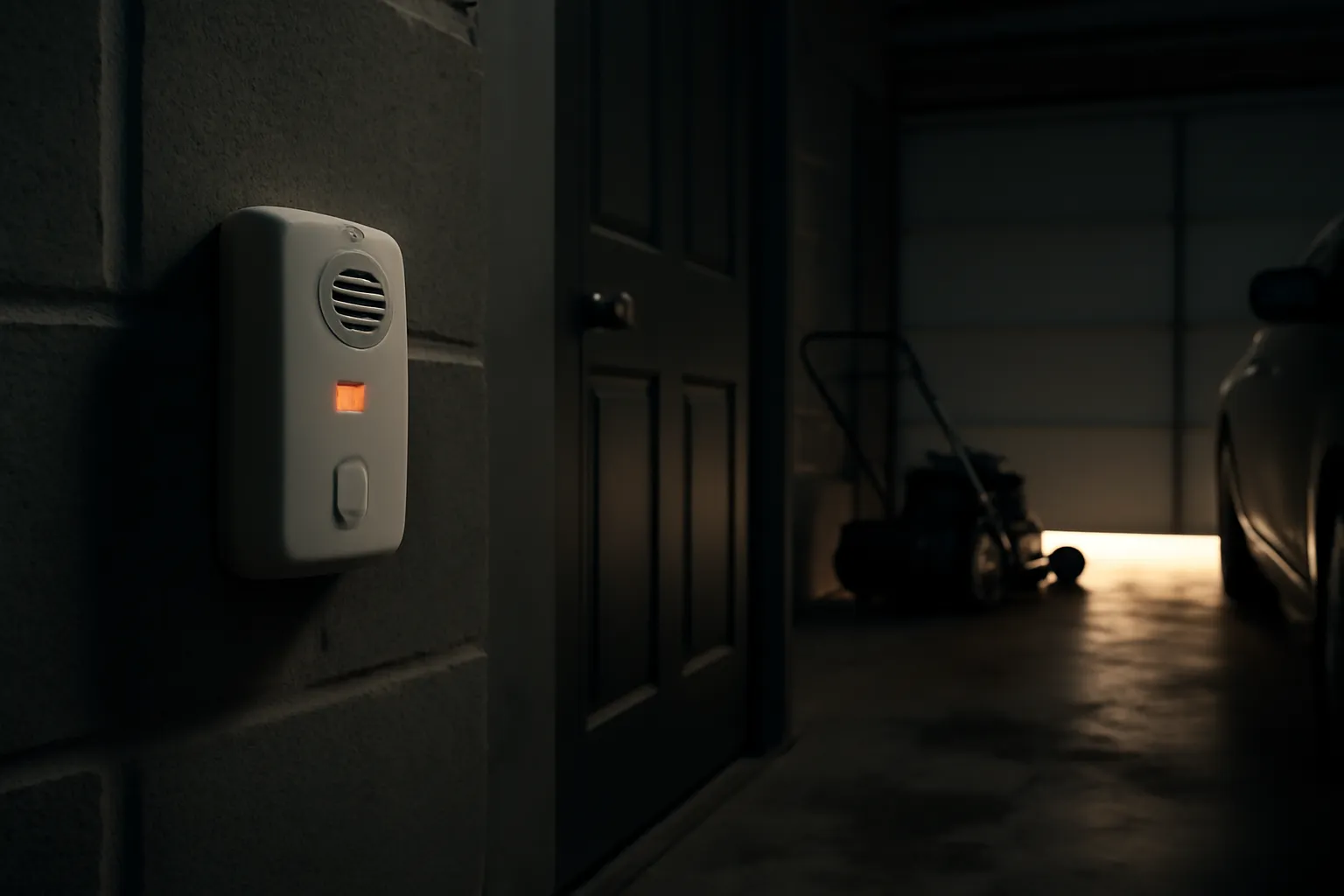
Thirty-five parts per million. That’s the figure my calibrated CO meter settled on inside a home office in a suburb outside Salt Lake City last spring — and the reading came a full two hours after the vehicle responsible for it had already pulled out of the driveway. The homeowner had been waking up with headaches for three straight weeks, the kind she’d chalked up to allergies or not drinking enough water. Her husband felt fine. Her teenage son felt fine. But she was the one working from home, parked at a desk in an office that shared a wall with the attached garage, every single morning while her husband let his truck idle for five minutes before heading to work. When I finally got a combustion analyzer and CO meter into that space, the office itself was still holding at 35 PPM. The garage on the other side of that wall? Sitting at 80 PPM. There was no detector mounted in the garage at all, and the standard residential unit in the hallway hadn’t made a sound. I bring this story up at every home performance training I attend now, because it sums up nearly everything homeowners get wrong about carbon monoxide detector garage workshop attached safety. The house had a detector. It just wasn’t in the right spot, and it wasn’t the right kind of detector to begin with. That gap is the subject of this entire post.
The Garage-to-House CO Danger Most Homeowners Never See Coming
Start with the basic chemistry, because it explains everything else. Carbon monoxide forms whenever a fuel — gasoline, propane, natural gas, wood — burns without quite enough oxygen to complete combustion. It has no color, no smell, and it’s only marginally lighter than air, which is exactly why the common advice to mount a detector low on the wall is wrong for CO (that guidance actually applies to propane, a heavier gas). CO spreads through a room pretty evenly instead of pooling.
Consider what happens the moment a car starts inside an attached garage. Consumer Product Safety Commission data, backed by independent combustion research, shows a typical gas-powered vehicle can push a standard two-car attached garage to 200–400 PPM within two to three minutes of ignition — and that’s with the garage door left open. Close the door and the number climbs even faster. Older engines or a cold start running rich can blow past 1,000 PPM in under five minutes.
Some context for those numbers: OSHA sets the permissible exposure limit for CO at 50 PPM across an eight-hour shift. NIOSH classifies 1,200 PPM as immediately dangerous to life and health. Most adults start showing symptoms around 70 PPM given enough exposure time. Yet the UL 2034 standard governing home CO detectors only requires an alarm at 70 PPM after 60 to 240 minutes of continuous exposure — intentionally, to avoid nuisance alarms. That’s a reasonable design choice, not a defect, but it also means the detector bolted to your hallway wall was never engineered to catch a fast spike from an idling engine. It’s built for a slow furnace leak, not a quick garage surge.
Placement drives nuisance alarms on the smoke side too — same principle, covered in relocating an over-sensitive smoke detector.
What catches most homeowners off guard is how easily CO travels from garage to living space. It doesn’t need a door standing open to get through. It finds its way via:
- Gaps under and around the fire-rated door separating the garage from the house
- Outlets and switch boxes set into the shared wall, which frequently sit uninsulated behind the cover plate
- Plumbing lines and conduit runs that pierce the shared wall
- HVAC ductwork routed through, or simply housed inside, the garage
- Recessed can lights installed in the ceiling directly above the garage
Keyless ignition adds its own layer of risk, and it’s worth calling out separately. NHTSA has linked push-button ignition systems to more than 100 deaths — vehicles left running by accident in a garage, often by older drivers who simply couldn’t hear or notice the barely-audible engine. Hybrids and gas-mode EVs make this worse, since they run even more quietly. This isn’t a rare edge case; it’s a documented, recurring cause of death.
Workshops raise the stakes even higher. Gasoline generators are, by a wide margin, the deadliest single source of residential CO poisoning nationwide. A typical 5,500-watt unit generates roughly the CO output of 450 cars idling at once. Run one inside an attached garage during a power outage — and people absolutely do, warning labels notwithstanding — and the situation turns lethal within minutes. Add propane heaters, gas-driven air compressors, and two-stroke equipment like pressure washers or chainsaws being tuned up, and you’ve got a legitimate need for real workshop CO detector placement, not an afterthought.
Here’s the detection problem nobody brings up: off-the-shelf residential CO detectors are only rated for 40°F to 100°F and 10–90% relative humidity (non-condensing). A Minnesota garage in January can sit at -10°F. A Phoenix garage in August can climb past 130°F. Throw in humidity from melting snow dripping off a car, rain, or a power washer, and electrochemical sensors degrade over time. That $25 detector from the hardware store will eventually malfunction, false-alarm on a loop, or quietly stop reading accurately in garage conditions. I’m not guessing here — I’ve pulled detectors out of garages that looked perfectly normal on the wall and tested completely dead inside.
The Monitor Built to Catch Slow, Chronic Garage CO Leaks
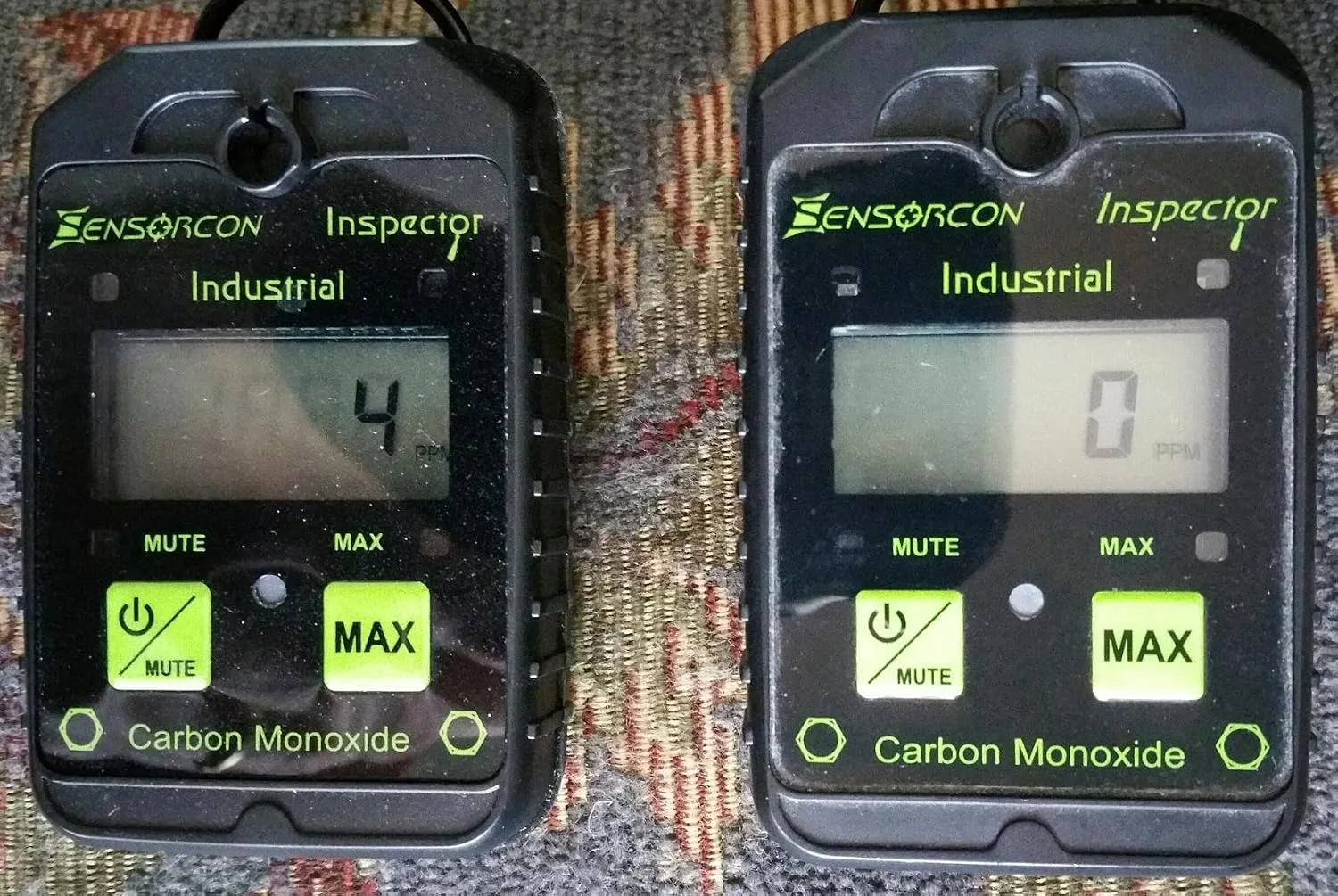
Most residential CO detectors exist to flag a sudden, catastrophic failure. What they miss is the slow-burn scenario — chronic leakage from an attached garage, especially during a cold-start idle — that stays below the alarm threshold for hours while producing the exact symptoms homeowners write off as stress or allergies. What you actually need is a monitor that tracks ambient CO continuously, rather than one that only reacts once levels reach a dangerous peak.
Where it earns its keep
- A live digital readout lets you actually watch CO concentration climb — so you catch a leaking garage door seal during morning warm-up instead of piecing it together after symptoms show up.
- Layered alerts — visual, audible, and vibration — matter in a garage or home office where a running engine or shop noise can drown out a standard beeper.
- Waterproof housing holds up to the temperature extremes and humidity swings of an unfinished garage without the readings drifting or the unit failing outright.
Where it comes up short
- Industrial-grade construction means bulkier hardware and a higher price tag than the $20 hardware-store unit sitting in most people’s hallway — the extra cost buys accuracy, not convenience.
- You need to already understand what safe CO exposure looks like (35 ppm over 8 hours, 200 ppm over 1 hour) — the display gives you the number, but interpreting it is on you.
When I first placed this monitor in that homeowner’s office and watched the reading climb to 28 ppm during her husband’s 5-minute warm-up routine, part of me hoped I was wrong about the garage door seal—but the data was undeniable. If you’re seeing unexplained morning symptoms and you have an attached garage, this is the clearest way to confirm what you’re actually breathing. Check the Sensorcon Industrial CO Carbon Monoxide Monitor with Visual, Audible and Vibrating Alerts, Waterproof.
About This Article

Written by Dana Sorensen. Homeowner turned building-science obsessive. I help other homeowners understand attic insulation, ventilation, and air quality so they can stay comfortable year-round without overspending on energy bills. More about this site.
Scope and limits. Dana is a homeowner who studies building science, not an HVAC contractor or licensed tradesperson. Anything involving combustion appliances, gas lines, or electrical work belongs with a licensed contractor.
Verify this against a primary source
Specifics change, and your situation may differ from the one described here. These are the authorities worth checking directly:
- ENERGY STAR — recommended insulation R-values by climate zone
- U.S. Department of Energy — air sealing and insulation guidance
- EPA Indoor Air Quality — ventilation and indoor air quality standards