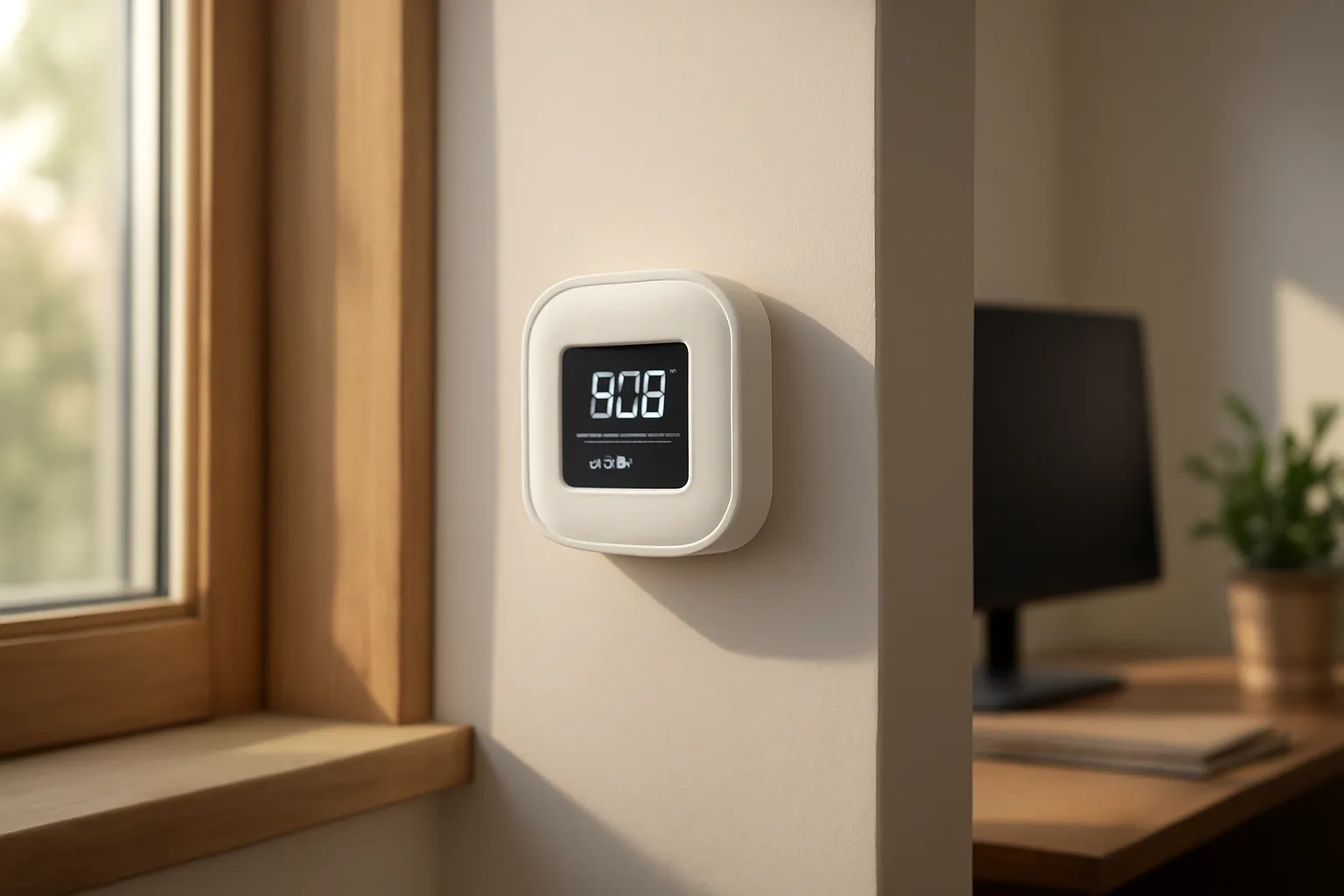
Spring thaw always does the same thing to a house: windows crack open after months sealed tight, and that first rush of fresh air has a way of exposing exactly how stagnant everything got while they were shut. I was mid-audit at a house going through that exact transition last spring — blower door test running, duct leakage numbers coming in, the usual checklist — when the homeowner mentioned, almost as an aside, that she’d been waking up with headaches nearly every morning for half a year. Mold was ruled out. Her doctor had seen her twice. She’d even swapped out her mattress on a hunch. Before I unpacked any of my own gear, I asked one question: had she ever tracked the CO2 level in her bedroom overnight? She looked at me sideways, then pointed toward her nightstand, where a $35 gadget from Amazon glowed a confident 650 PPM on its display. “I’ve already got a CO2 monitor,” she told me. “It always reads fine.” So I set my calibrated NDIR meter down next to hers, closed the bedroom door, and let both units run for twenty minutes side by side. Hers landed at 680 PPM. Mine landed at 2,340 PPM. Same room, same air, wildly different stories. Turns out her $35 device wasn’t measuring carbon dioxide at all — it was crunching VOC data through an algorithm and handing her a number designed to feel comforting. That number had been lying to her every single night she slept in that room. If you’re hunting for the best CO2 monitor for home NDIR sensor technology, this is the guide that keeps you from repeating her mistake — and maybe solves a mystery symptom of your own along the way.
Why So Many Budget CO2 Monitors Aren’t Measuring CO2 At All
Here’s what gets under my skin every time I browse a hardware aisle or scroll through online listings: the letters “CO2” show up on plenty of products that, in any real sense, aren’t tracking CO2. The packaging looks legitimate, the price tag feels painless, and homeowners snap them up by the thousands assuming they’ve got the problem covered. They don’t.
Let’s pull back the cover on what these gadgets are actually doing internally, because once you see the hardware difference, the sleight of hand stops being subtle.
How Genuine CO2 Sensors Work: NDIR Technology
An authentic CO2 monitor relies on what’s known as a Non-Dispersive Infrared (NDIR) sensor. The concept is straightforward and dependable: air enters a small chamber, and infrared light beams through it. CO2 molecules soak up infrared energy at one exact wavelength — 4.26 micrometers. A detector positioned on the far side clocks how much of that wavelength got absorbed, and that absorption number translates directly into a molecule count. This is genuine physics at work, measuring the actual compound in question.
Depending on build quality, NDIR sensors land within roughly ±30–75 PPM of true readings, last anywhere from 10 to 15 years before needing replacement, and form the backbone of professional air-quality tools, lab equipment, and commercial HVAC systems alike. When one of these sensors displays 1,800 PPM, the room genuinely holds around 1,800 PPM of carbon dioxide. No asterisk needed.
The Imitation: eCO2 and “Equivalent CO2” Readings
This is where things get murky. A totally separate — and much cheaper — sensor type is the Metal Oxide Semiconductor (MOS) VOC sensor. Instead of carbon dioxide, it tracks volatile organic compounds: alcohol vapors, cleaning chemicals, body odor, kitchen smells. Manufacturers pay pennies on the dollar for these compared to true NDIR hardware.
Somewhere along the line, manufacturers noticed that in a room full of people, VOC readings and CO2 readings tend to climb together — both rise simply because occupants are exhaling CO2 and shedding VOCs at the same time. So they built an algorithm that guesses at a CO2 figure using the VOC input. That guess gets slapped with a label like “eCO2” (estimated CO2), “equivalent CO2,” or sometimes just plain “CO2” with zero clarification.
Here’s the catch: the tie between VOCs and CO2 is thin, unreliable, and collapses entirely once real life gets involved. Crack a window, cook a meal, spritz a cleaning product, run an essential-oil diffuser — any one of these can send your VOC reading skyrocketing and drag the eCO2 estimate along for a wild ride. Under everyday household conditions, these sensors can miss the mark by 500 PPM or more. Stack up NDIR against eCO2 sensor accuracy and there’s no real contest — an eCO2 sensor isn’t a watered-down version of true CO2 monitoring. It’s an entirely different measurement wearing the same units for cover.
Warning Signs to Catch Before You Purchase
When you’re running your own indoor air quality CO2 monitor comparison, watch for these red flags in any product listing:
- The listing uses “eCO2,” “equivalent CO2,” or “estimated CO2” anywhere in the specs
- It’s priced under $40 yet claims CO2 measurement — that’s about as close to a guarantee of an eCO2 sensor as you’ll get, since genuine NDIR components alone cost more than that to produce
- The spec sheet labels the sensor “electrochemical” or skips naming the sensor type altogether
- Accuracy numbers are fuzzy, buried, or simply absent
- VOC measurement gets top billing on the product page with no explanation of how CO2 supposedly gets derived from it
When a listing states plainly “NDIR sensor” and backs it with a concrete accuracy figure like ±50 PPM ±3%, you’ve found a legitimate CO2 monitor. That combination of details is exactly what you should be scanning for.
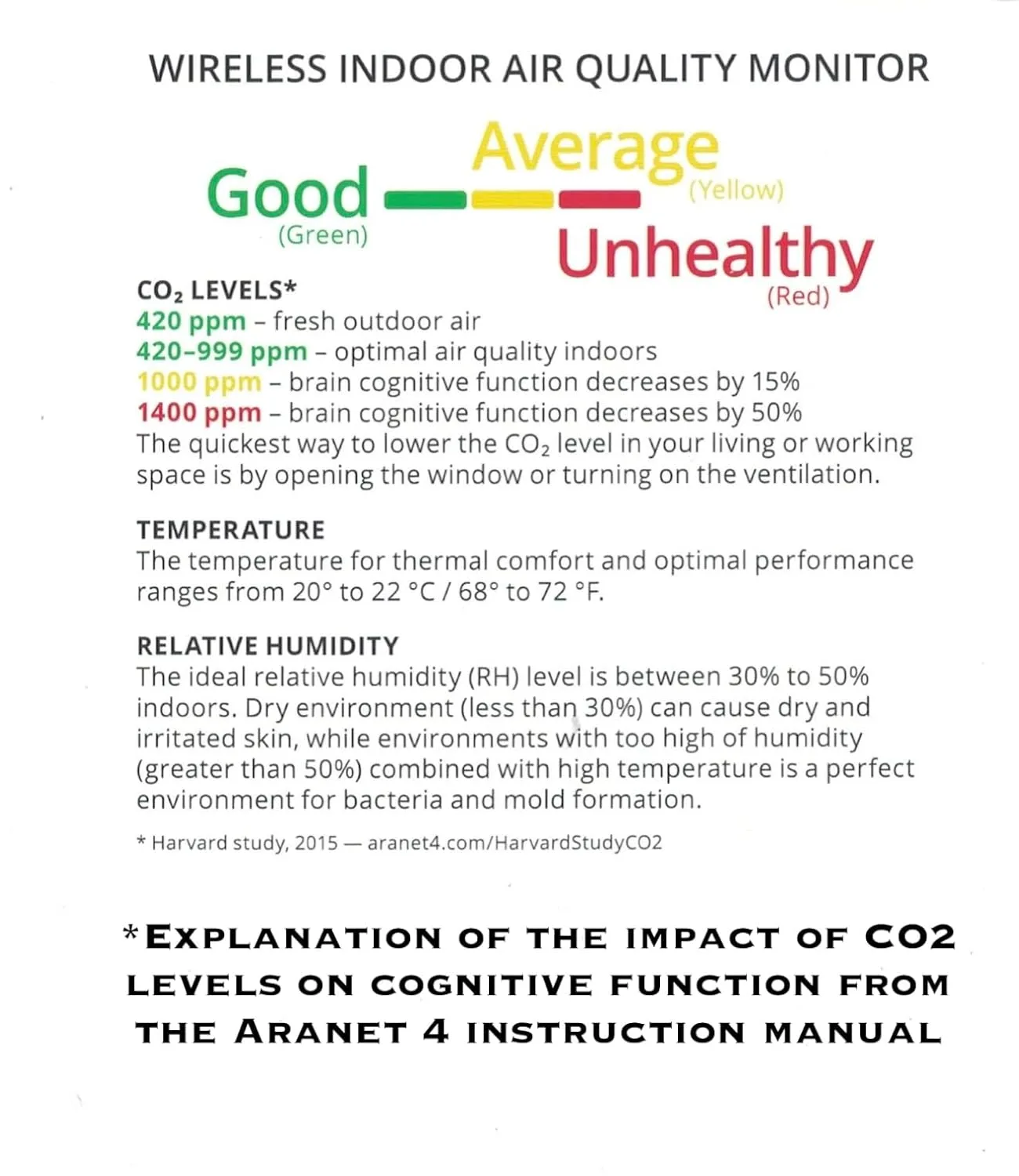
So why does any of this matter beyond bragging rights on accuracy? Because CO2 concentration acts as a stand-in for how well a space is being ventilated. Outdoor air currently sits around a 420 PPM CO2 baseline. ASHRAE Standard 62.1 — the ventilation benchmark used throughout building design — calls for keeping indoor CO2 under 1,100 PPM in occupied areas. Study after study points to cognitive performance slipping noticeably once levels cross 1,000–1,200 PPM, and headaches, fatigue, and restless sleep tend to track right alongside prolonged CO2 buildup in bedrooms. When your monitor is feeding you fiction, you have zero real insight into whether your home’s ventilation is doing its job — and in newer, tightly sealed houses, it frequently isn’t.
The Device That Finally Confirmed What Was Actually Happening
Most bargain CO2 sensors hand you numbers that wander erratically or freeze at implausible plateaus — poor factory calibration means they drift within a matter of weeks. When the stakes involve something as serious as chronic morning headaches, you need numbers you can actually stand behind.
The upsides
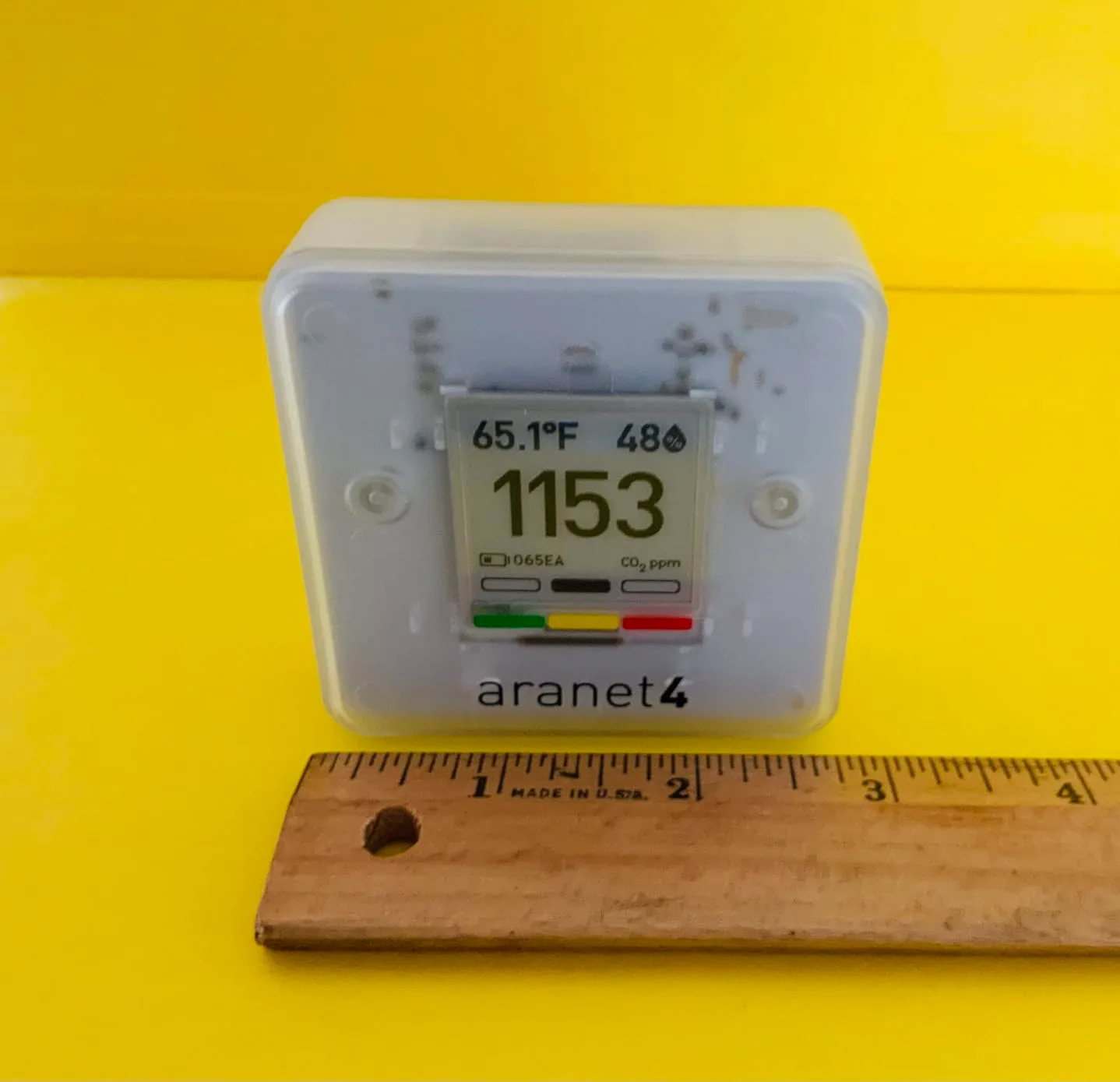
- Comes factory calibrated and holds that accuracy for months on end — I’ve cross-checked it against my own professional-grade equipment and it consistently lands within 50 ppm
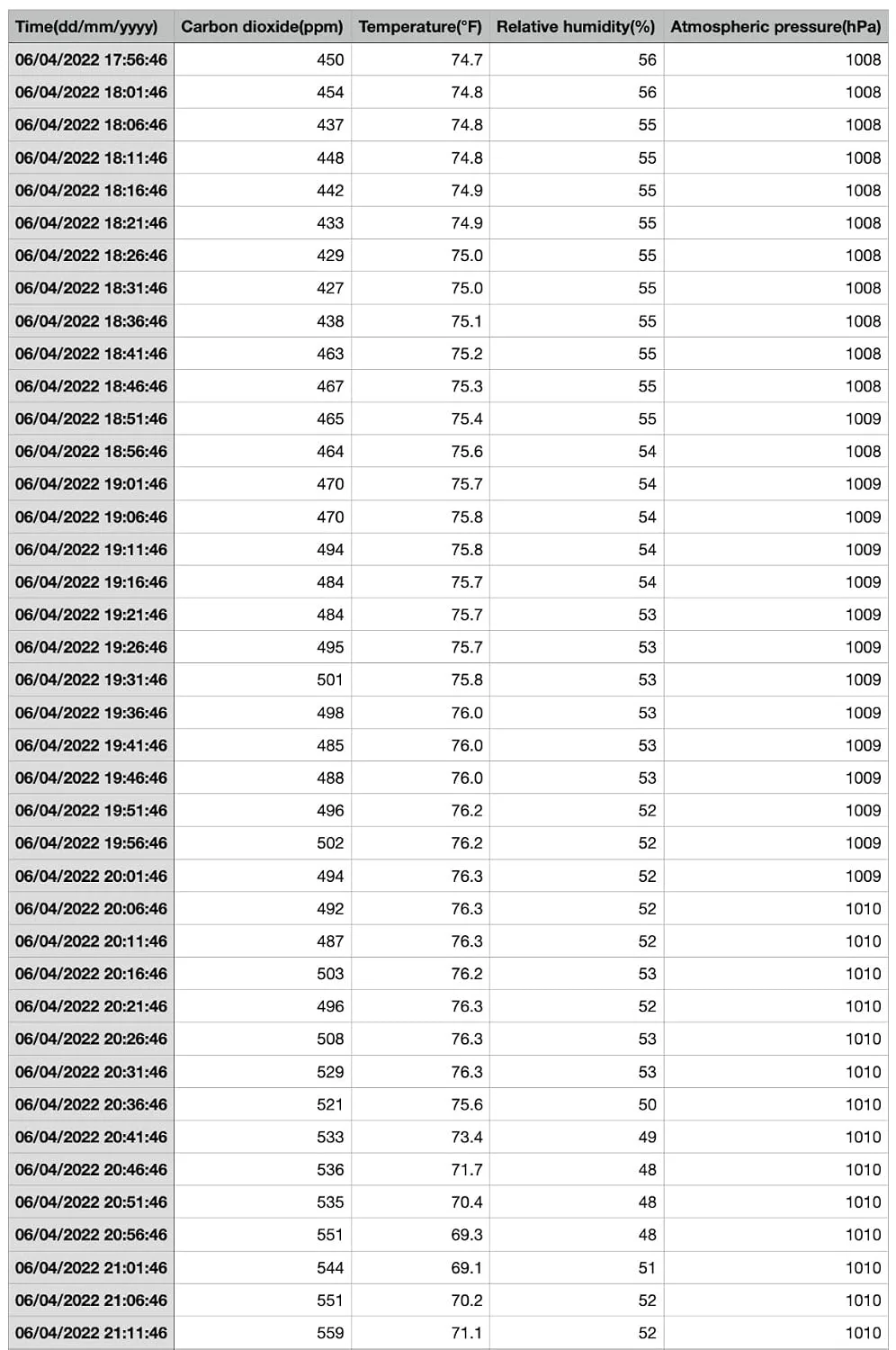
- Overnight logging captures the actual CO2 climb while you’re asleep, which is exactly the point — you wake up to solid data instead of a hunch
- Straightforward enough that no manual is required, yet rigorous enough that the numbers hold up when compared against a follow-up blower door test or energy audit
The downsides
- The cost — north of $200 puts it out of impulse-buy territory, which explains why so many people grab the cheap $30 imposters instead
- App syncing can trail live readings by a few minutes, so anyone watching the numbers obsessively in real time will get annoyed — this thing is built for overnight logging, not moment-to-moment monitoring
I almost didn’t recommend it to this homeowner because I knew the sticker shock would sting—but then she spent one night logging data and texted me the graph at 6 a.m., and suddenly the investment made sense. If you’re serious about understanding what’s actually in your bedroom air, grab the Aranet4 Home Indoor Air Quality Monitor.
About This Article

Written by Dana Sorensen. Homeowner turned building-science obsessive. I help other homeowners understand attic insulation, ventilation, and air quality so they can stay comfortable year-round without overspending on energy bills. More about this site.
Scope and limits. Dana is a homeowner who studies building science, not an HVAC contractor or licensed tradesperson. Anything involving combustion appliances, gas lines, or electrical work belongs with a licensed contractor.
Verify this against a primary source
Specifics change, and your situation may differ from the one described here. These are the authorities worth checking directly:
- ENERGY STAR — recommended insulation R-values by climate zone
- U.S. Department of Energy — air sealing and insulation guidance
- EPA Indoor Air Quality — ventilation and indoor air quality standards