Why does one CO detector chirp feel like nothing at all while another sends you sprinting outside with the kids at 3 a.m.? Because the two sounds aren’t carrying the same message — and mixing them up is exactly how people end up either evacuating for nothing or ignoring something that could actually kill them. Take Karen, a homeowner I worked with last spring: at 2:47 in the morning she was standing in her driveway in a bathrobe, her two kids buckled into a running car, because her detector had started beeping. She did exactly what she should have — get everyone out first, sort out the details later. When I arrived with my combustion analyzer, the reading came back clean: zero carbon monoxide anywhere in that house. What her unit had actually been signaling was a single chirp every 30 seconds — the low-battery pattern, nothing more. She’d made the safe choice, but she had no idea what that specific pattern meant, and that’s the real problem here. I’d rather respond to a hundred unnecessary evacuations than have one person ignore a genuine CO alarm, but the issue isn’t that homeowners are careless — it’s that nobody ever actually walks you through what those beeps mean. Four beeps versus three. A chirp every 30 seconds versus a continuous shriek. Each pattern is telling you something entirely different, and in a real emergency, knowing which one you’re hearing is the difference between calling an electrician after breakfast and dialing 911 right now. So let’s go through them one by one, based on what years of working on my own house and reading the building science have taught me, so you’re never left guessing again.
Chirps and beeps are one thing; a full alarm with no fire is another. For that, read a smoke alarm that keeps tripping for no reason.
Why CO Detector Beep Patterns Exist — and What’s Actually Behind Them
Carbon monoxide shows up whenever combustion doesn’t go the way it should — any fuel-burning appliance (a furnace, water heater, gas range, fireplace, generator, even a car engine) will produce CO instead of CO₂ the moment it isn’t getting enough oxygen to burn cleanly. You can’t see it, smell it, or taste it; a sensor is the only real way to know it’s present. Around 70 parts per million (PPM), you’ll start noticing headaches and nausea. Push into the 150-200 PPM range and dizziness and confusion set in. Cross 400 PPM and the situation turns genuinely life-threatening within a matter of hours. At 1,600 PPM, symptoms — headache, dizziness, nausea — arrive in roughly twenty minutes, with about an hour before exposure becomes potentially fatal. None of those numbers are exaggerated for effect; they’re documented physiological response levels. But here’s the part that trips people up: those figures are not the same as the thresholds that make a UL 2034-listed alarm sound, and that distinction matters a great deal. UL 2034 requires a certified detector to alarm somewhere between 60 and 240 minutes of exposure at 70 PPM, between 10 and 50 minutes at 150 PPM, and between 4 and 15 minutes at 400 PPM — and below 70 PPM, it isn’t required to respond at all. Symptom levels and alarm thresholds are two entirely separate scales, and that gap is exactly how people get poisoned inside a home with a detector that’s functioning exactly as it was designed to.
Having multiple alert tones isn’t a design shortfall — it’s deliberate. Each sound is the unit’s way of ranking urgency for you, and once you know the shared pattern language, the mystery disappears. Here’s how the industry-standard signals break down across most major manufacturers:
The Four Beep Patterns You Need to Recognize
- Four beeps, a pause, then four beeps again, on repeat: This is the genuine CO alarm — carbon monoxide has crossed the alarm threshold inside your home. Treat it as real every single time. Get everyone outside immediately, leave the door open behind you, call 911 once you’re clear of the building, and don’t go back in until fire crews confirm it’s safe using a professional-grade combustion analyzer. One important note: resist the urge to open windows on your way out. It feels like the logical move, but airing the space out before responders arrive can disperse the CO and make it much harder for them to pinpoint the source. Leave the conditions as they are and let the fire department do their job.
- One chirp every 30 to 60 seconds: This is the low-battery signal. It isn’t an emergency, but don’t put it off either — swap the battery within a day or two. The sensor itself is still working fine; it’s just running on fading power.
- A single chirp every 30 seconds that keeps happening even after you’ve put in a fresh battery: That’s the unit telling you it’s reached the end of its life. The electrochemical sensor inside has a limited lifespan — usually 5 to 7 years — and once it’s expired, new batteries won’t make the chirping stop. At that point, the whole detector needs replacing.
- Three beeps, a pause, three beeps, repeating: This signals a fault or malfunction — the detector has failed its own internal self-check. Take it out of service and replace it right away; a detector that isn’t working properly isn’t providing any protection at all.
- Continuous beeping with no rhythm or pause: This usually points to a malfunction, a stuck test button, or an internal hardware failure. Handle it the same way as a fault reading — pull it from service.
These signals line up with the audible-alarm differentiation guidelines in UL 2034 and NFPA 72 (Chapter 29, which absorbed the withdrawn NFPA 720 back in 2019), though I always tell homeowners to pull out the manual for their specific model and double-check. Some manufacturers use slightly different beep counts. The underlying logic holds across the board, but the exact sequence can vary by brand.
Why Your Detector Always Picks the Middle of the Night to Chirp
This is one of the most common complaints I run into: “it only ever goes off at 3 a.m.” There’s no conspiracy at work — it’s plain physics. Battery voltage dips slightly as temperature drops, and as your house cools overnight, the battery in your detector loses just enough voltage to slip below the low-battery threshold, setting off the chirp. Once things warm up in the morning, voltage recovers and the chirping stops on its own — which convinces people the issue is random or intermittent when it’s actually entirely predictable. The fix is straightforward: replace the battery the moment it happens rather than whenever it’s convenient, and consider stepping up to a sealed lithium battery model or a hardwired unit that removes battery voltage from the equation altogether.
How a Digital-Display Detector Ended My 3 A.M. Guessing Games
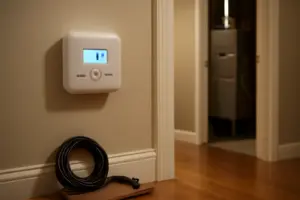
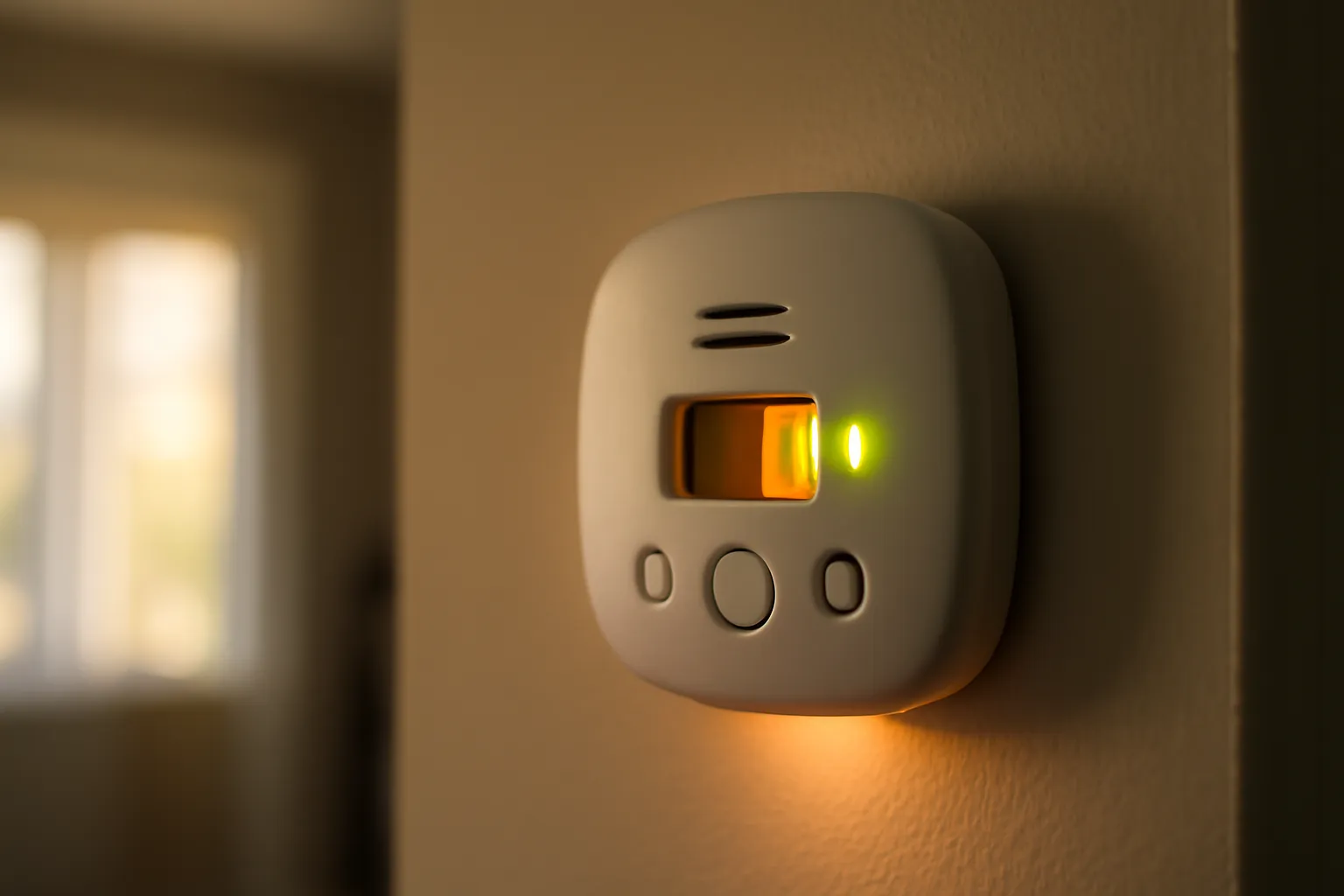
After one too many midnight scrambles caused by nothing more than a dying battery, I switched to a CO detector with a digital readout that actually spells out what’s happening. No more standing there wondering whether your alarm is warning you about carbon monoxide or just a worn-out 9V battery.
Where It Earns Its Keep
- You get a live numeric CO reading right on the unit, so you know within seconds whether you’re facing a real threat or a false alarm — no more standing outside in your robe at 2:47 in the morning trying to figure it out.
- A sealed 10-year battery means you’re not swapping batteries every couple of years, and when attention is needed, the display states it plainly instead of leaving you to decode a beep pattern.
- It also displays ambient temperature, which turns out to be genuinely handy when you’re troubleshooting HVAC problems or checking whether your furnace is cycling the way it should.
Where It Falls Short
- The display runs on its own backup battery — a standard 9V — so even with a 10-year sensor battery, you’ll still eventually get a low-battery alert, just for a different component of the unit.
- It’s somewhat bulkier than a basic detector, which matters if you’re installing it in a tight hallway or a small corner bedroom.
I’ll admit I was skeptical that the display would actually save me from false alarms — until I had a unit beeping at a rental property and could see “0 ppm” in bright digits instead of wondering if I needed to evacuate. Pick up the First Alert CO710A 10-Year Carbon Monoxide Alarm with Temperature & Digital Display if you’re tired of decoding beep patterns at odd hours.
About This Article

Written by Dana Sorensen. Homeowner turned building-science obsessive. I help other homeowners understand attic insulation, ventilation, and air quality so they can stay comfortable year-round without overspending on energy bills. More about this site.
Scope and limits. Dana is a homeowner who studies building science, not an HVAC contractor or licensed tradesperson. Anything involving combustion appliances, gas lines, or electrical work belongs with a licensed contractor.
Verify this against a primary source
Specifics change, and your situation may differ from the one described here. These are the authorities worth checking directly:
- ENERGY STAR — recommended insulation R-values by climate zone
- U.S. Department of Energy — air sealing and insulation guidance
- EPA Indoor Air Quality — ventilation and indoor air quality standards