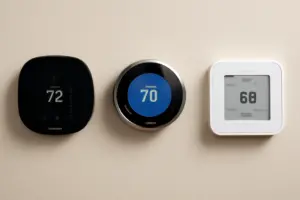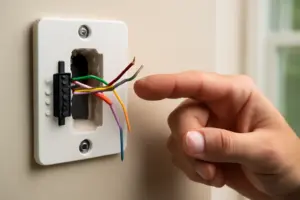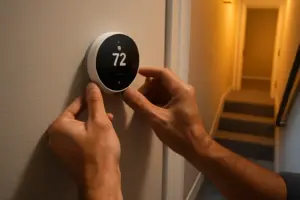
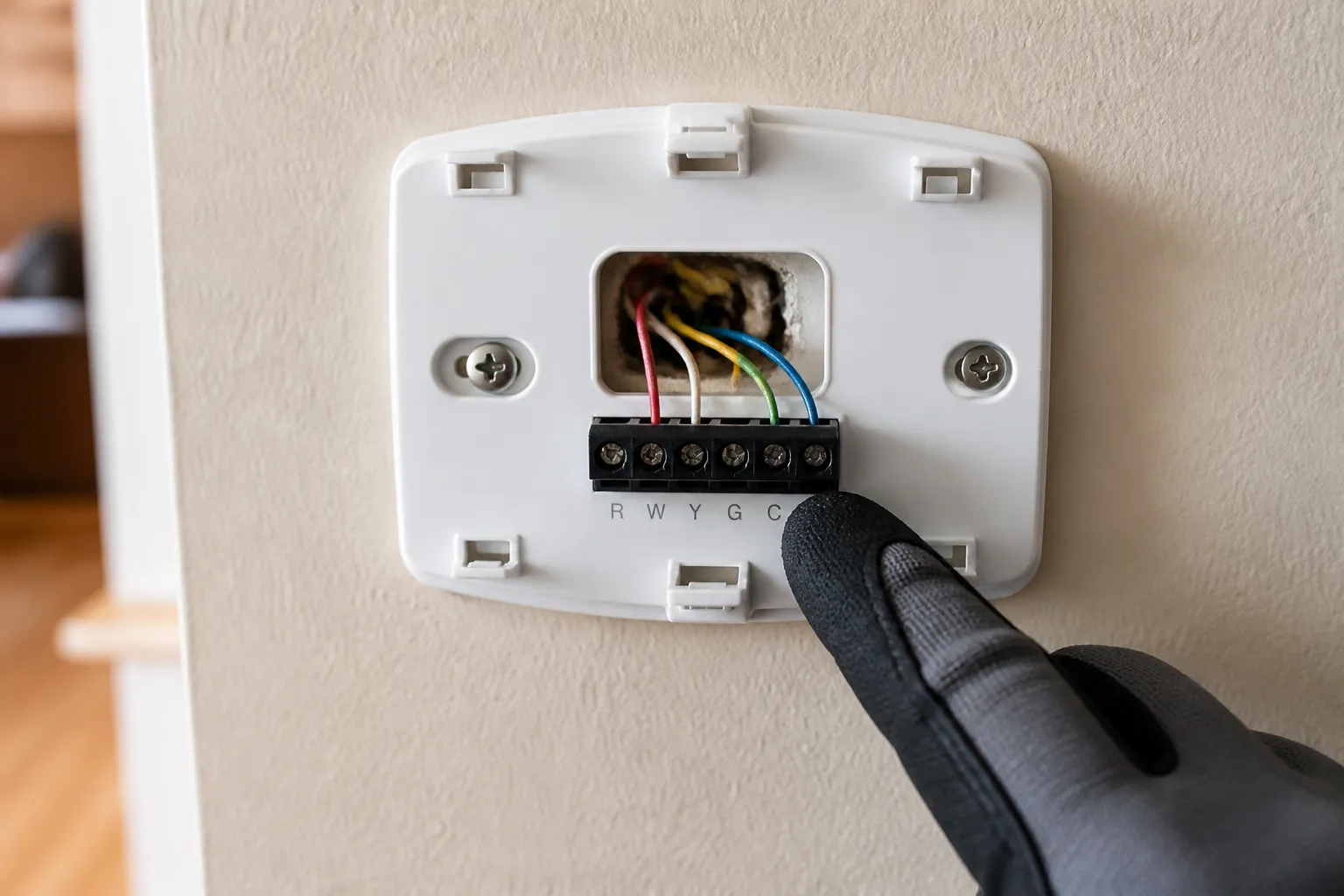
A manufacturer’s spec sheet will tell you the model number, the voltage draw, the WiFi frequency, even the screen resolution — every detail except the one that actually decides whether your new thermostat will work once it’s mounted on the wall. Nowhere in that glossy documentation does anyone mention that most homes built before the 2000s were never wired for what a smart thermostat actually requires. I run into this gap constantly: someone buys a Nest or Ecobee, pulls the old thermostat off the wall after watching a YouTube tutorial, and finds four connected wires plus one empty terminal marked “C” staring back at them. Batteries drain within days. The furnace short-cycles for no obvious reason. Or the box just sits unopened on the counter while the install gets pushed to “next weekend.” Figuring out what is the C wire on a thermostat — and what to do when your house doesn’t have one — is the difference between a fifteen-minute swap and a service call that costs real money. Here’s what’s actually happening behind that wall plate, explained the way I lay it out on site.
The Real Reason Smart Thermostats Demand a C Wire
Start with the basics sitting inside your equipment cabinet. Your furnace or air handler houses a low-voltage transformer that puts out 24 volts AC, and that transformer has two terminals worth knowing: “R,” the hot leg supplying power, and “C,” the common leg that carries it back. Picture a basic loop — R is the positive side, C the negative — with electricity traveling from R through the thermostat wiring to whatever component needs to fire (the compressor, a heating relay, the blower motor) before returning through C to close the loop at the furnace.
The old-school thermostats, the ones built around a bimetallic coil that flexed with temperature swings, sipped almost no electricity at all because they were entirely mechanical — just a switch opening and closing. A common wire was irrelevant to them. Digital models showed up in the ’90s running on battery power, cycling through a seven-day program without asking much of a couple of AA or AAA cells.
Smart thermostats operate on a different level entirely. A WiFi radio has to stay live around the clock so it can catch commands from your phone, on top of a color touchscreen, onboard processors, and sensors logging conditions nonstop. That’s why an Ecobee or Nest pulls somewhere between 200 and 300 milliamps just sitting idle — well beyond what disposable batteries can support. These units need steady 24-volt power straight from the transformer, and steady power only happens with a closed loop: R carrying current in, C carrying it back out.
Skip the C wire and the thermostat will attempt to borrow power from whichever wire happens to be active — the fan or heating leg, typically — whenever that system kicks on. It’s an unreliable trick that tends to backfire as furnace short-cycling, phantom alerts, or the thermostat blinking off unexpectedly. Calling it a workaround gives it too much credit; it’s a patch over a wiring gap that needs a real fix.
Walk through an older house with me and the absence of a connected C wire has a boring explanation: the original thermostat never needed one, so whoever installed it never ran or connected it. That doesn’t mean the wire isn’t sitting inside the wall already, and it doesn’t mean one can’t be added. What matters is knowing exactly what’s behind the plate and which paths are open to you.
“Common” Explained — And Why Wire Color Can’t Be Trusted
“C” is short for “common,” and in electrical language, common describes the return path — the negative reference point completing the circuit. When a tech mentions “common,” they mean the conductor carrying power back to its source rather than delivering it outward.
On the subject of wire colors — there’s an accepted convention, though it’s more guideline than law:
- R (red): the 24V feed leaving the transformer (hot leg)
- C (blue or black): the 24V return leg back to the transformer (common leg)
- Y (yellow): signals the compressor for cooling
- G (green): signals the blower fan
- W (white): signals the heating call
- O or B (orange or brown): controls the reversing valve on heat pump setups
Reality looks messier than any chart. Installers — particularly in older houses — often used whatever wire color happened to be inside the sheath and just labeled it at the furnace board to match. I’ve come across common wires in purple, orange, even a red that wasn’t actually “R.” The label matters far more than the insulation color. That’s precisely why the first move I make at any thermostat is snapping a photo of the existing wiring with every label visible. Colors mislead; labels don’t.
A Smart Thermostat Built for Houses Without a C Wire
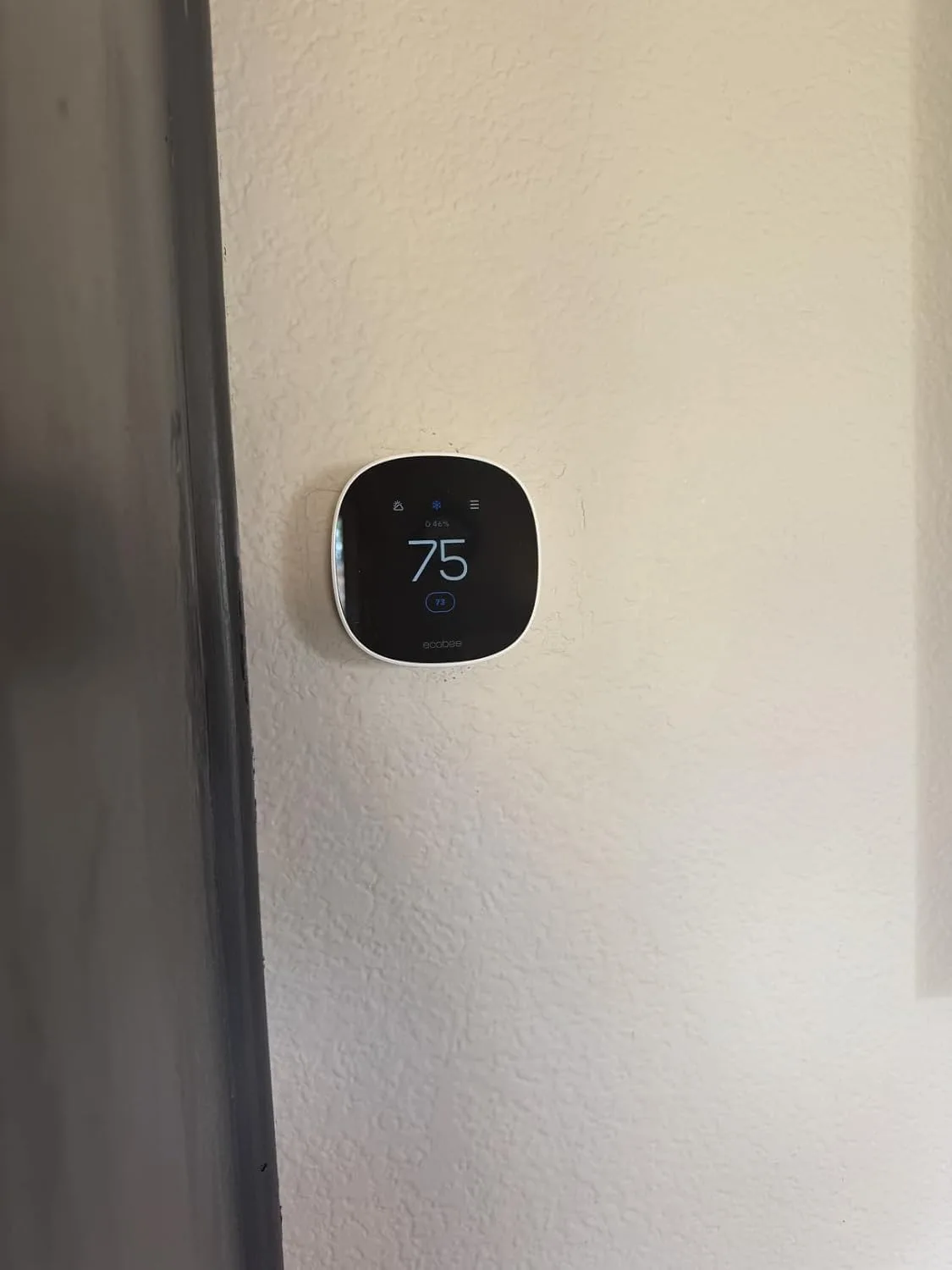
If you fall into the large group of homeowners running an older furnace with no C wire ever routed to the thermostat, most smart thermostats on shelves today will leave you stuck. The Ecobee Smart Thermostat Essential is the model I pointed that stressed-out homeowner toward, and it’s still what I reach for whenever running new wire isn’t in the cards.
Where It Delivers
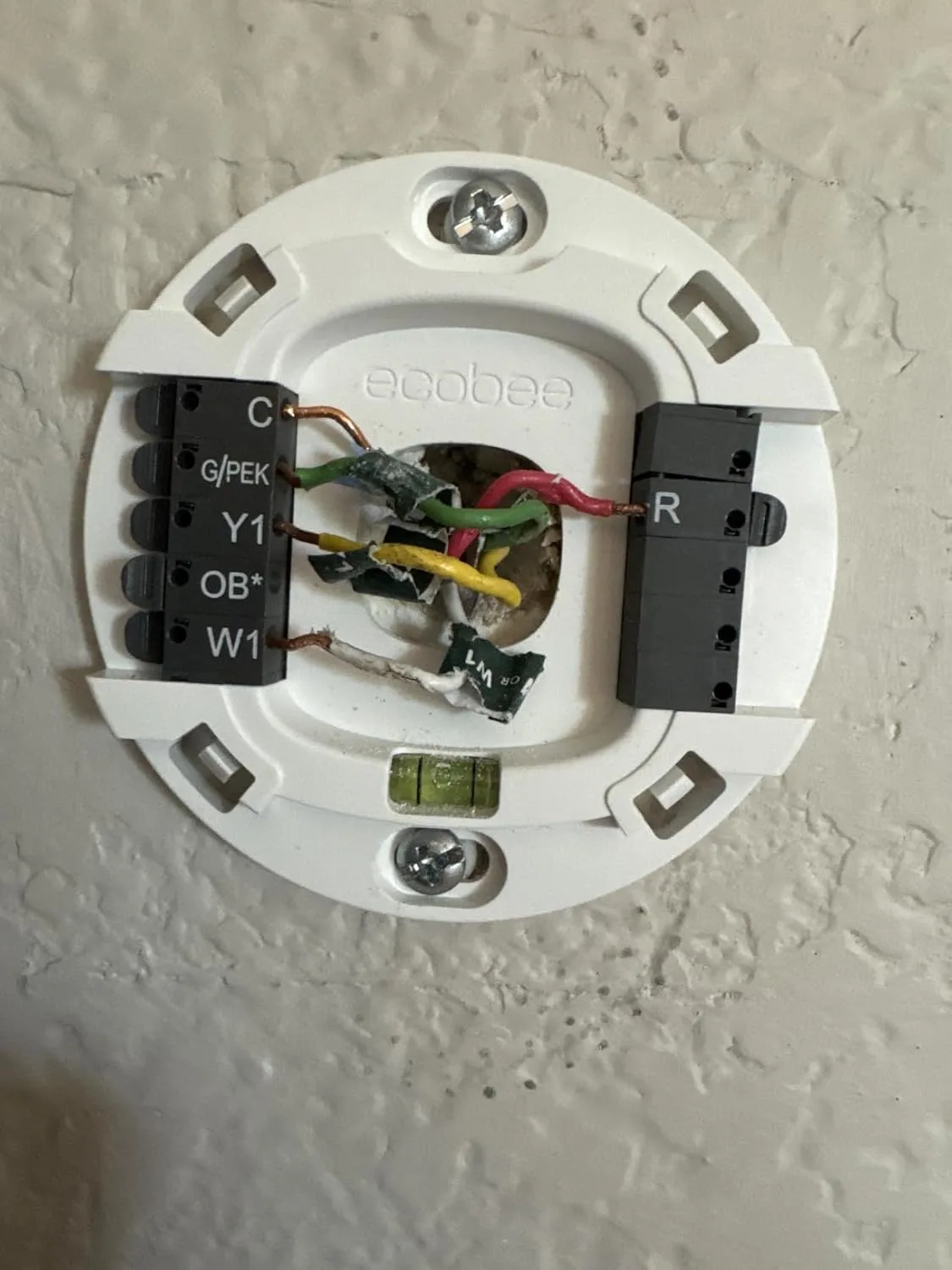
- Its built-in power extender kit lets it run without a dedicated common wire — a genuine save for older systems that only ever had four or five wires pulled to begin with.
- The manual includes a straightforward, color-coded wiring diagram that walks you terminal by terminal, cutting out the guesswork that had my caller stuck at his kitchen counter.
- Add-on remote sensors track temperature room by room, which helps you figure out whether uneven heating traces back to the furnace itself or to duct problems.
Where It Falls Short
- That power extender kit means one more box crammed into your furnace closet, which gets old fast if space was already tight.
- You’ll need a smartphone and a Wi-Fi connection to set it up, so a router stationed on the far side of the house can mean weak signal and app hiccups mid-install.
I had one moment of doubt when I saw the power extender kit for the first time—one more piece to mount, one more potential failure point—but three years and dozens of installations later, it’s been rock solid. If you’re staring at a C-wire gap in your wiring and a smart thermostat is non-negotiable, grab the Ecobee Smart Thermostat Essential.
Where the C Wire Actually Came From
People ask me for a date on this a lot, and I get why — it feels like it should have an invention story, a patent, a “Eureka” moment. It doesn’t. There is no year you can point to and say “that’s when the C wire was invented,” because the C wire was never invented as a thing in itself. It’s one leg of a 24-volt transformer circuit, and that circuit’s history is really just the history of low-voltage thermostat control in general.
The real starting point: bimetallic thermostats
Before low-voltage control existed at all, thermostats were either line-voltage devices or purely mechanical ones. The bimetallic strip — two different metals bonded together that bend as they heat up, eventually closing an electrical contact — is the real ancestor here, and that technology traces back to the late 1800s. Warren Johnson’s room thermostat work in the 1880s is the usual reference point historians and manufacturers cite, and it’s the same Johnson whose company eventually became Johnson Controls. But these were switches, not electronics, and they didn’t need a “C” anything.
Why 24 volts became standard
The part that actually matters for your question happened later, as forced-air furnaces with electric blower motors spread through homes in the mid-20th century. Manufacturers landed on a 24-volt control transformer as the standard — safer to work with than line voltage, and cheap enough to run on thin bell-wire-style cable instead of heavier gauge conductors. That transformer has two sides: R, the hot leg, and C, the common leg that completes the circuit. So the C terminal has existed on furnace control boards for as long as 24V control itself has. It’s not new. It’s baked into the system from day one.
Why so many houses still don’t have the wire
Here’s the part that actually explains the confusion. A mechanical or bimetallic thermostat doesn’t need power to operate — it’s just a switch. It closes the R and W legs to call for heat and draws nothing to do it. So for decades, installers ran 4-conductor thermostat cable and simply left the C conductor unused at the thermostat end, because there was no reason to land it. The wire wasn’t invented late — it was left disconnected because nothing on the wall needed it. Battery-powered digital thermostats through the 1990s and into the 2000s kept that pattern going for another generation.
- Bimetallic thermostats (late 1800s): mechanical switches, no C wire needed
- 24V forced-air control (mid-1900s): C terminal exists on the board, but often unused at the thermostat
- Battery digital thermostats (1990s–2000s): status quo continues
- WiFi smart thermostats (2011 onward): continuous power needed, C wire suddenly matters
The term only entered everyday homeowner vocabulary once WiFi-connected thermostats showed up needing continuous power for a radio and a display — a load that AA batteries just can’t sustain long-term. Nest’s 2011 launch is the marker most people in this hobby use, not because it invented anything electrically, but because it’s when this stopped being an installer-only concern and started showing up in living rooms.
So the honest answer: if your system runs on 24V control — which the overwhelming majority of residential forced-air systems do — the C terminal almost certainly already exists inside your furnace or air handler. The open question is only whether a conductor was ever run from there to the thermostat. That’s why adding a C wire is a wiring job, not an equipment upgrade.
About This Article

Written by Dana Sorensen. Homeowner turned building-science obsessive. I help other homeowners understand attic insulation, ventilation, and air quality so they can stay comfortable year-round without overspending on energy bills. More about this site.
Scope and limits. Dana is a homeowner who studies building science, not an HVAC contractor or licensed tradesperson. Anything involving combustion appliances, gas lines, or electrical work belongs with a licensed contractor.
Verify this against a primary source
Specifics change, and your situation may differ from the one described here. These are the authorities worth checking directly:
- ENERGY STAR — recommended insulation R-values by climate zone
- U.S. Department of Energy — air sealing and insulation guidance
- EPA Indoor Air Quality — ventilation and indoor air quality standards