Understanding rigid foam board insulation where to use it correctly is one of those things that sounds straightforward until you’re standing in the lumber aisle staring at three different colors of foam board, all roughly the same thickness, all claiming to be the right choice for your project. I got a call last spring from a homeowner in northern Utah who had just finished framing out his basement walls and was ready to insulate. He’d already bought twelve sheets of silver foil-faced foam board — polyiso — because it had the highest R-value per inch on the label. Made sense to him. More R-value, better insulation, right? I had to break some news to him before he started cutting panels.
That silver polyiso he was holding loses roughly 25–30% of its rated R-value in cold conditions — and a below-grade basement wall in Utah sees exactly those conditions. He’d have been better served by the blue or pink board he’d walked right past. He wasn’t dumb. The packaging just doesn’t tell you what it doesn’t tell you. In fifteen years of doing home performance assessments and HVAC work, I’ve pulled out incorrectly specified foam board more times than I can count. White board below slab where XPS belonged. Polyiso against a rim joist where it was seeing repeated freeze-thaw cycles. EPS on a cathedral ceiling application where every R-value point matters. Each one of those mistakes cost somebody money — either in material replacement, energy bills, or both.
This guide is going to walk you through the real differences between EPS, XPS, and polyiso — not the marketing differences, the building science differences — and tell you exactly where each one belongs in a house.
Understanding the Problem: Why Foam Board Type Actually Matters
Most homeowners assume rigid foam is rigid foam. The core confusion is understandable — all three types look like insulation, cut with similar tools, and come in familiar thicknesses like 1-inch and 2-inch panels. But the chemistry, the cellular structure, and the moisture behavior are completely different between them. Picking the wrong one isn’t like picking the wrong paint color. It can mean a wall assembly that traps moisture, an insulation layer that underperforms by 30% in the season you need it most, or a product that slowly degrades when it contacts what you glued it with.
EPS — Expanded Polystyrene (The White Beadboard)
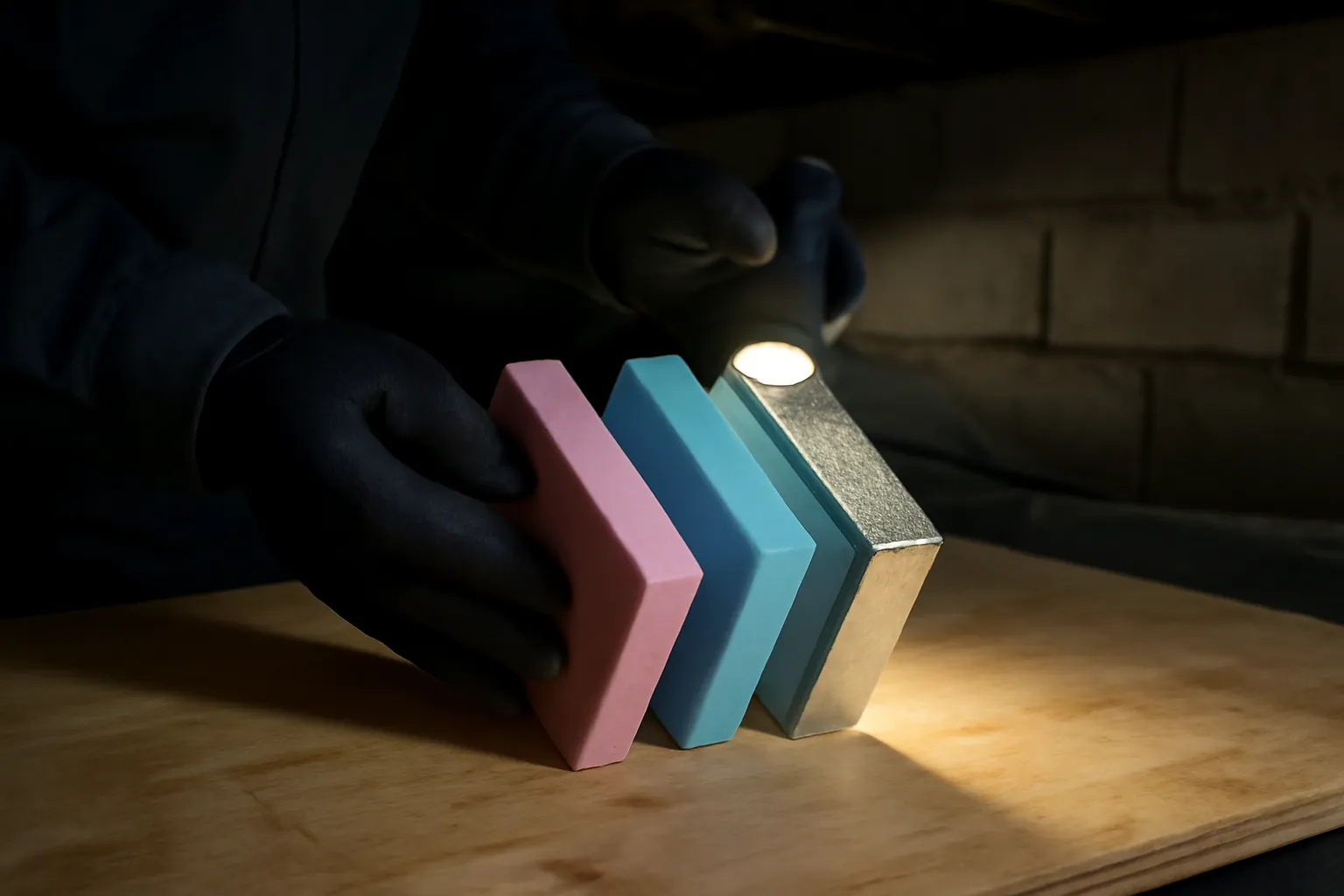
EPS is the white, bead-textured board — the same material as a coffee cup. It’s the least expensive of the three and delivers R-3.6 to R-4.2 per inch depending on density. The key characteristic people miss: EPS is vapor-permeable. It will absorb some moisture over time, though it also dries out when conditions change. For applications where you actually want some drying potential — like exterior foundation walls above grade — that’s acceptable. Under a concrete slab it works well because you’re protecting it from bulk water on both sides. It’s also the most environmentally forgiving in terms of blowing agents. Where it struggles: anywhere with sustained moisture exposure or high compressive load requirements at thin thicknesses.
XPS — Extruded Polystyrene (The Blue or Pink Board)
XPS is manufactured through an extrusion process that creates a closed-cell structure — meaning each cell is sealed, which dramatically reduces moisture absorption. It delivers a consistent R-5.0 per inch, holds that value well across a wide temperature range, and has excellent compressive strength (typically 25 PSI at 10% deformation for standard residential grade). This makes it the right choice for below-grade applications: basement walls, below-slab insulation where moisture resistance is critical, and rim joist insulation where you’re dealing with that vulnerable intersection of foundation, sill plate, and floor system. The closed-cell structure also gives it a vapor retarder function — at 2 inches thick, XPS typically runs around 1.0 perm, which is meaningful in moisture management strategies for basements.
Polyiso — Polyisocyanurate (The Silver Foil-Faced Board)
Polyiso is the high-performance board, rated at R-6.0 to R-6.5 per inch at room temperature — the best labeled R-value per inch of any rigid foam. The foil facer also acts as a radiant barrier when facing an air space. But here’s the critical building science detail that sent my Utah client back to the store: polyiso is temperature-sensitive. Laboratory testing and real-world monitoring have consistently shown that polyiso R-value degrades significantly at low temperatures. At 25°F, you’re looking at effective R-values closer to R-4.5 per inch — a drop of roughly 25–30% from the labeled value. In a cold-climate above-grade wall or roof application where the assembly stays warm enough, polyiso excels. On an attic roof deck, a cathedral ceiling, or an above-grade exterior continuous insulation layer, it earns its higher price. Put it below grade or anywhere it’ll consistently see temperatures below 40°F, and you’ve paid a premium for performance that won’t materialize when the weather is worst.
One more thing worth mentioning here: the foam board insulation R-value comparison numbers on product packaging are tested at 75°F mean temperature. That’s not real-world for most of the applications homeowners are trying to insulate. Always factor in where the insulation plane will actually be in your thermal envelope before buying based on label R-value alone.
The Blue XPS That Finally Stopped Me From Confusing Basement Foam Types
When you’re insulating below-grade spaces like basements or rim joists, moisture resistance becomes non-negotiable—and that’s exactly where most DIYers grab the wrong board. XPS foam (the blue stuff) is specifically engineered for below-grade use because it resists moisture absorption far better than expanded polystyrene, but you have to actually reach for it instead of the cheaper white or pink alternatives.
What works
- Closed-cell structure keeps water out—the R-value stays stable even if the basement gets damp or there’s minor seepage
- The foil facing on these boards adds a vapor barrier right there, so you’re not layering on extra materials or tape in tight rim joist spaces
- Cuts cleanly with a utility knife, and the 2-inch thickness gives you solid R-value (roughly R-10) without eating up foundation wall space
What doesn’t
- Cost is noticeably higher than white bead board—you’ll pay roughly 2–3× more per sheet, which adds up on larger projects
- If you’re in a dry, above-grade application like an attic rafter, you’re overpaying for moisture resistance you don’t actually need
I almost talked that Utah homeowner into returning his silver board and starting over, which felt wasteful until I ran the numbers on what mold remediation costs down the road. If basement or below-grade insulation is in your plans, grab the LuckyFoam Blue 4 Pack 15x12x2 inch Polystyrene XPS Foam Board and stop second-guessing yourself in the lumber aisle.
This post contains affiliate links. As an Amazon Associate, I earn from qualifying purchases at no extra cost to you.