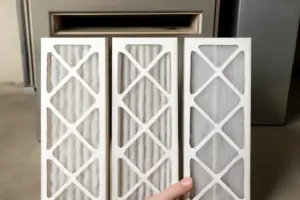
A mismatched air filter can quietly wreck a perfectly healthy furnace — and that’s exactly what greeted me last month at a house in Edina. The homeowner was fed up: his electric bill had jumped 18% over the winter, the upstairs bedroom stayed stubbornly cold, and the equipment seemed to never shut off. A quick look inside the furnace cabinet explained everything: a brand-new MERV 13 filter had been wedged into a 1-inch slot that was never engineered to accept one.
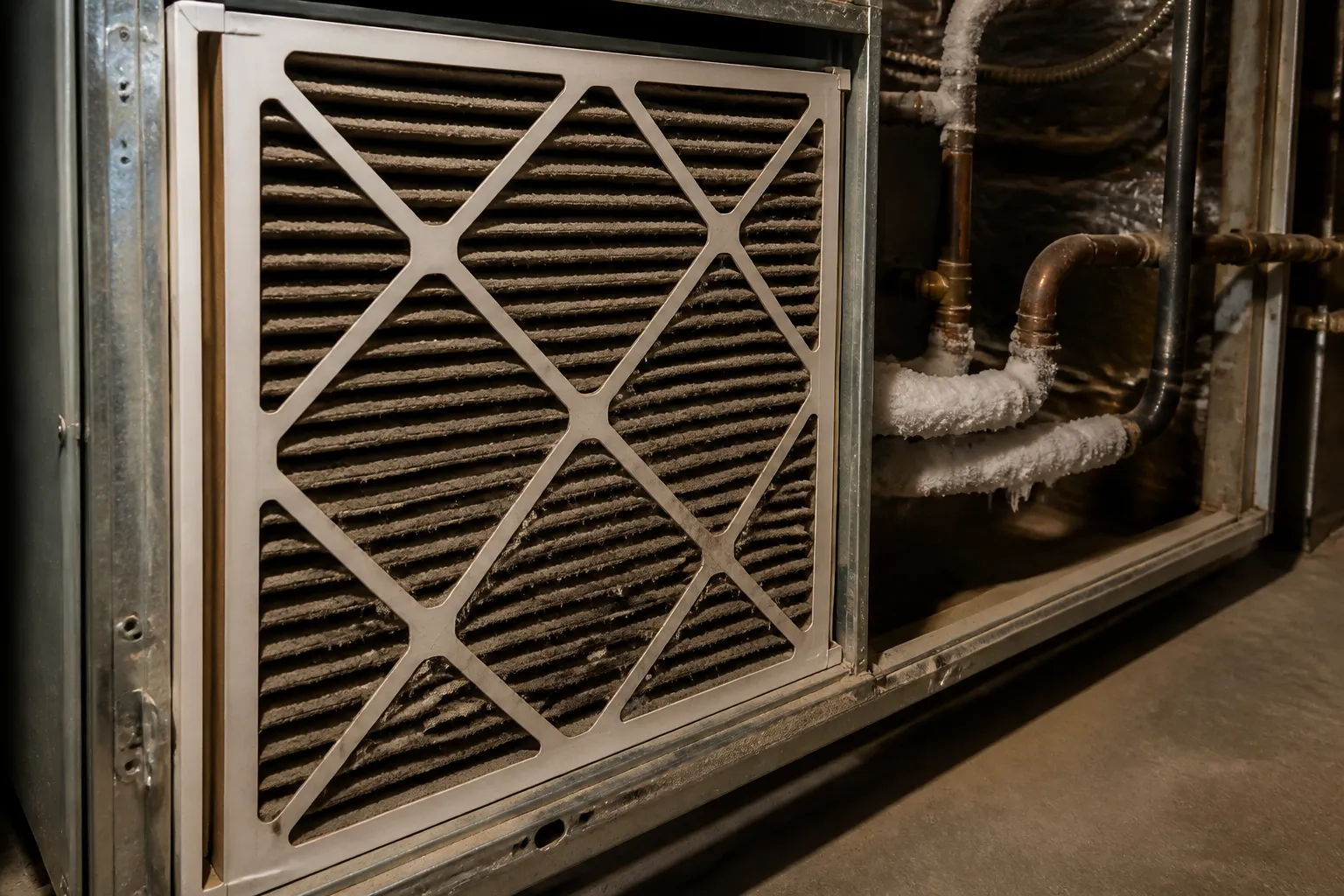
Somewhere along the way he’d picked up the idea that a higher MERV number automatically meant cleaner indoor air, so he’d swapped out the standard MERV 8 the manufacturer had specified. What he hadn’t accounted for was that his furnace — a solid, still-capable 15-year-old unit — now had to fight twice as hard to drag air through media built for residential homes rather than a house. His evaporator coil sat on the edge of icing over, his blower motor was straining under the load, and his utility bill was footing the bill for all of it.
I see this same story unfold in homes all over Minnesota and the broader Upper Midwest month after month: people chasing cleaner air without grasping what their equipment was actually built to tolerate. The frustrating part is that he could have captured roughly 80% of that air quality gain, with no performance trade-off whatsoever, just by stepping up to a MERV 11 filter instead.
In this post, I’m breaking down the MERV 8 versus MERV 13 argument the way a technician sees it, laying out what your equipment can genuinely tolerate, and pointing you toward the practical middle-ground filter that fits the majority of homes.
Why MERV 13 Filters Backfire in Homes Built for Something Else
MERV — short for Minimum Efficiency Reporting Value — is a standardized scale created by ASHRAE (the American Society of Heating, Refrigerating and Air-Conditioning Engineers) to describe how effectively a filter traps particles of varying sizes. It stretches from MERV 1 up to MERV 20, and the part most people miss is this: the higher you climb on that scale, the smaller the particles a filter can grab — but the more resistance it throws in front of moving air.
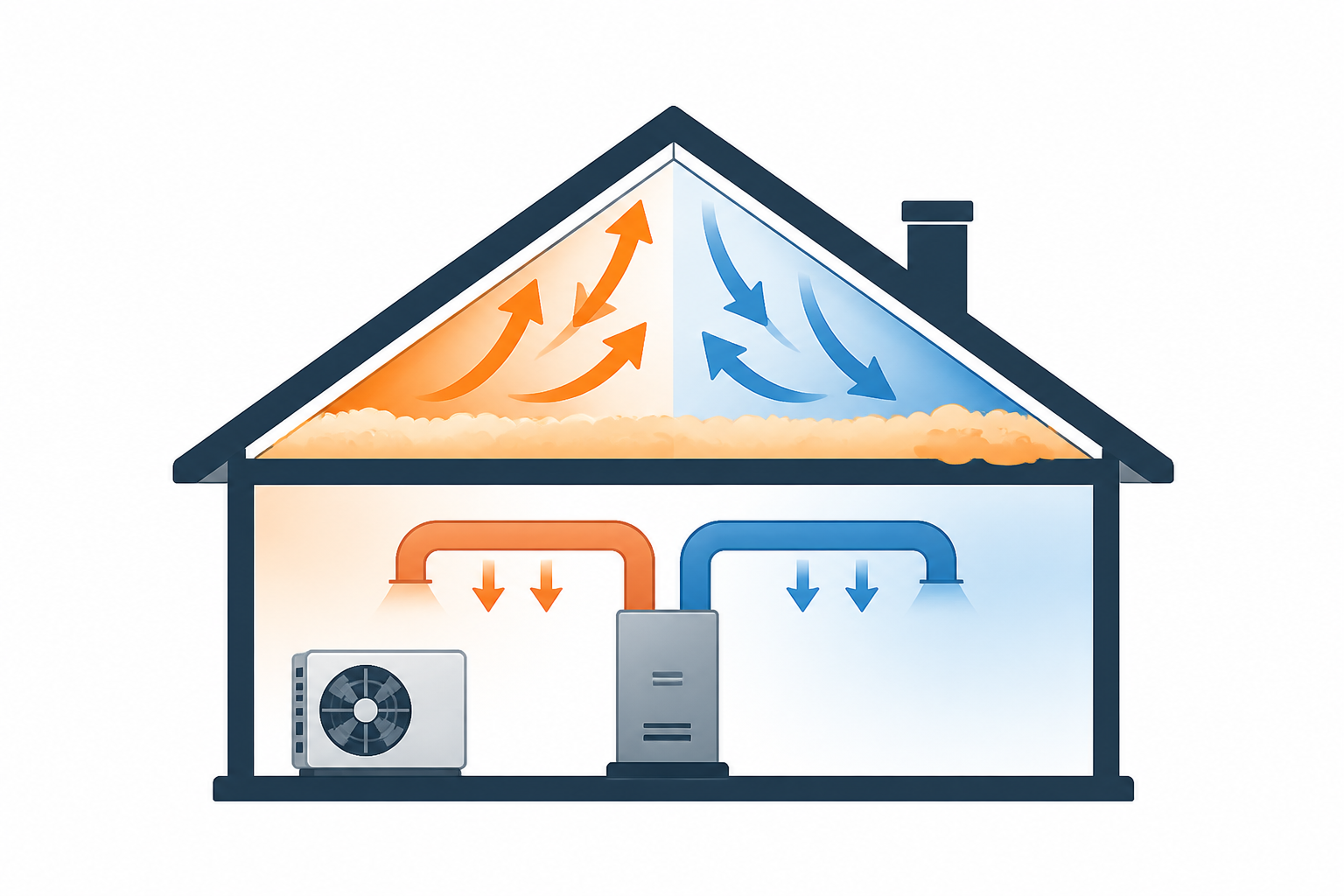
That resistance is where the trouble usually starts. Shoppers spot “MERV 13” advertised as the premium filtration option and assume it’s a straightforward upgrade, without realizing that the blower motor and duct system tied to that furnace were never sized to shove air through such tightly-woven media. The physics doesn’t bend: thicker, denser filter material means air has a harder time getting through, which means more static pressure, which means the blower has to work that much harder to move the same volume of air.
Technicians quantify that resistance in inches of water column (w.c.), referred to as static pressure. The vast majority of residential systems — including roughly 80% of what you’ll find installed around the Twin Cities — are designed to run at a total external static pressure (TESP) below 0.5 inches of water column.
Push past that ceiling, and here’s the chain reaction that follows:
- Airflow drops off — the blower simply can’t force enough air through, so your rooms receive less conditioned air than they should
- Cycles stretch out — the furnace or AC ends up running almost nonstop trying to hit the thermostat’s target
- Coils freeze over — during cooling season, sluggish airflow across a cold coil lets condensation turn to solid ice, cutting off refrigerant circulation
- Compressors take the hit — once that ice melts, liquid refrigerant can flood back into the compressor (a condition called “slugging”), and that can mean catastrophic failure
- Utility bills climb — longer runtimes translate into more fuel or electricity spent for the exact same heating or cooling output
- Overall capacity shrinks — your home simply takes longer to heat or cool because there isn’t enough air being moved
Even a fresh, unused MERV 13 filter can tack on 0.20 to 0.35 inches of water column in static pressure the moment it’s installed. Layer on a grimy blower wheel, tight ductwork, or a dust-choked return grille, and you can easily land 50% beyond what the system was ever designed to handle. That’s not a small annoyance — that’s the setup for an outright breakdown.
Here’s the part that stings most: for the average household, the actual air quality difference between MERV 8 and MERV 13 filtration is modest at best. You’re giving up a meaningful chunk of system performance in exchange for a filtration boost your lungs likely won’t even register.
The MERV Scale Explained: What Each Tier Is Actually Built For
Before getting into fixes, let’s walk the full MERV lineup so you understand precisely what you’re picking when you grab a filter off the shelf:
- MERV 1-4 (disposable fiberglass filters) — Only trap large debris and coarse dust. Barely worth counting for air quality purposes; their job is protecting the equipment, not your lungs. You’ll typically spot these in budget apartment buildings and homes.
- MERV 5-7 (entry-level pleated filters) — Trap somewhat larger dust, a portion of pollen, dust mite fragments. Offers only a marginal step up from MERV 4. Still not something I’d suggest for households dealing with allergies or pets.
- MERV 8 (the default residential filter) — This is most likely the rating your furnace was engineered around. Handles pollen, mold spores, pet dander, dust mite debris, and lint. A solid balance between filtration and airflow — most homes perform fine here as long as you replace it on schedule.
- MERV 9-11 (upgraded pleated filters) — Catch finer dust particles, exhaust residue, and some bacteria. Adds a bit of airflow resistance but stays within safe limits for most residential setups. This is the zone I typically point allergy-prone households toward.
- MERV 12 (high-efficiency tier) — Captures the majority of 1-micron particles. Noticeably restricts airflow. You should verify your system can handle it before installing. Getting close to the edge of what a 1-inch filter slot can accommodate.
- MERV 13 (hospital-level filtration) — Captures smoke, most bacteria, and some viruses. Demand spiked during COVID as people sought pandemic-level protection. Creates substantial airflow resistance and needs equipment specifically designed to accommodate it. Not a good match for standard 1-inch filter slots.
- MERV 14-16 (clean-room grade) — Simply not appropriate for residential duct-mounted filters, full stop. These call for dedicated filter housings installed by a professional.
- MERV 17-20 (HEPA-level filtration) — Belongs in dedicated air purification equipment, not a standard duct filter slot. Think medical and laboratory settings, not a typical home HVAC system.
The MERV scale looks linear on paper, but the real-world math isn’t intuitive at all. Going from MERV 8 to MERV 13 doesn’t translate into a 60% jump in air quality — it’s closer to a 15-20% improvement in particle capture paired with a 300-400% spike in airflow resistance. For most households, that’s a lopsided trade that isn’t worth making.
Figuring Out What Your Own System Can Actually Take
The very first thing I ask any homeowner: what size is your filter slot?
A 1-inch filter slot — the standard configuration in the majority of residential furnaces — tells you the system was built around MERV 8 to MERV 10, at the outside. These slots are convenient and easy to service, but they’re also shallow, offering limited surface area and filter thickness. Trying to run a MERV 13 through that format is fighting an uphill battle against physics.
A 4-inch or 5-inch media filter cabinet — think Honeywell’s F100, the Aprilaire 2000 line, or Lennox media filters — is the proper way to run higher filtration. These units offer dramatically more surface area and are purpose-built to accept MERV 13 and above without choking airflow. You’ll pay for it upfront, roughly $200-400 for the housing plus a bit more per filter, but you’ll only be swapping filters once a year instead of every 30-60 days.
To pin down what your own equipment allows:
- Dig up your furnace’s manual and check for the maximum MERV rating and TESP thresholds
- Examine the filter slot itself — the frame or label frequently lists the maximum MERV allowed
- Reach out to your homeowner — the installation paperwork should have your system’s exact design specs on file
- Not sure at all? Default to MERV 8 until you confirm otherwise
Don’t leave it to chance. A quick five-minute phone call to your local HVAC company costs a lot less than a $3,000 compressor replacement.
MERV 11: The Filter That Cleans Without Choking Your System
If your 1-inch slot has become a rotating cast of well-meaning but ill-fitting MERV 13 filters, a MERV 11 pleated filter is generally the answer — strong enough to trap dust and pet dander without strangling your blower motor or gutting your airflow.
Where it earns its keep
- Slides into a standard 1-inch slot with no modifications or forcing required, so nothing’s under strain from the moment you install it.
- Delivers a real, visible improvement in air quality — less dust settling on surfaces, fewer allergy triggers — without the static pressure penalty that comes with MERV 13.
- Outlasts a MERV 8 thanks to its pleated construction catching more debris, yet doesn’t clog nearly as fast as higher-rated filters tend to in a standard system.
Where it falls short
- Doesn’t trap particles as thoroughly as a MERV 13 or 16 — households with severe allergies or multiple pets may still notice a gap in performance.
- Demands consistent swap-outs — a clogged MERV 11 restricts airflow just like any other filter, so set a reminder every 60-90 days and stick to it.
I’ll admit, the first time I talked a neighbour out of MERV 13 in favour of MERV 11 — he was convinced “higher is always better” — I got that skeptical look, until his electric bill dropped and his bedroom actually stayed warm. Try a MERV 11 pleated filter like the Filtrete 20x25x1 Air Filter, MERV 11, MPR 1000 and see if it’s the real fix your system has been asking for.
About This Article

Written by Dana Sorensen. Homeowner turned building-science obsessive. I help other homeowners understand attic insulation, ventilation, and air quality so they can stay comfortable year-round without overspending on energy bills. More about this site.
Scope and limits. Dana is a homeowner who studies building science, not an HVAC contractor or licensed tradesperson. Anything involving combustion appliances, gas lines, or electrical work belongs with a licensed contractor.
Verify this against a primary source
Specifics change, and your situation may differ from the one described here. These are the authorities worth checking directly:
- ENERGY STAR — recommended insulation R-values by climate zone
- U.S. Department of Energy — air sealing and insulation guidance
- EPA Indoor Air Quality — ventilation and indoor air quality standards