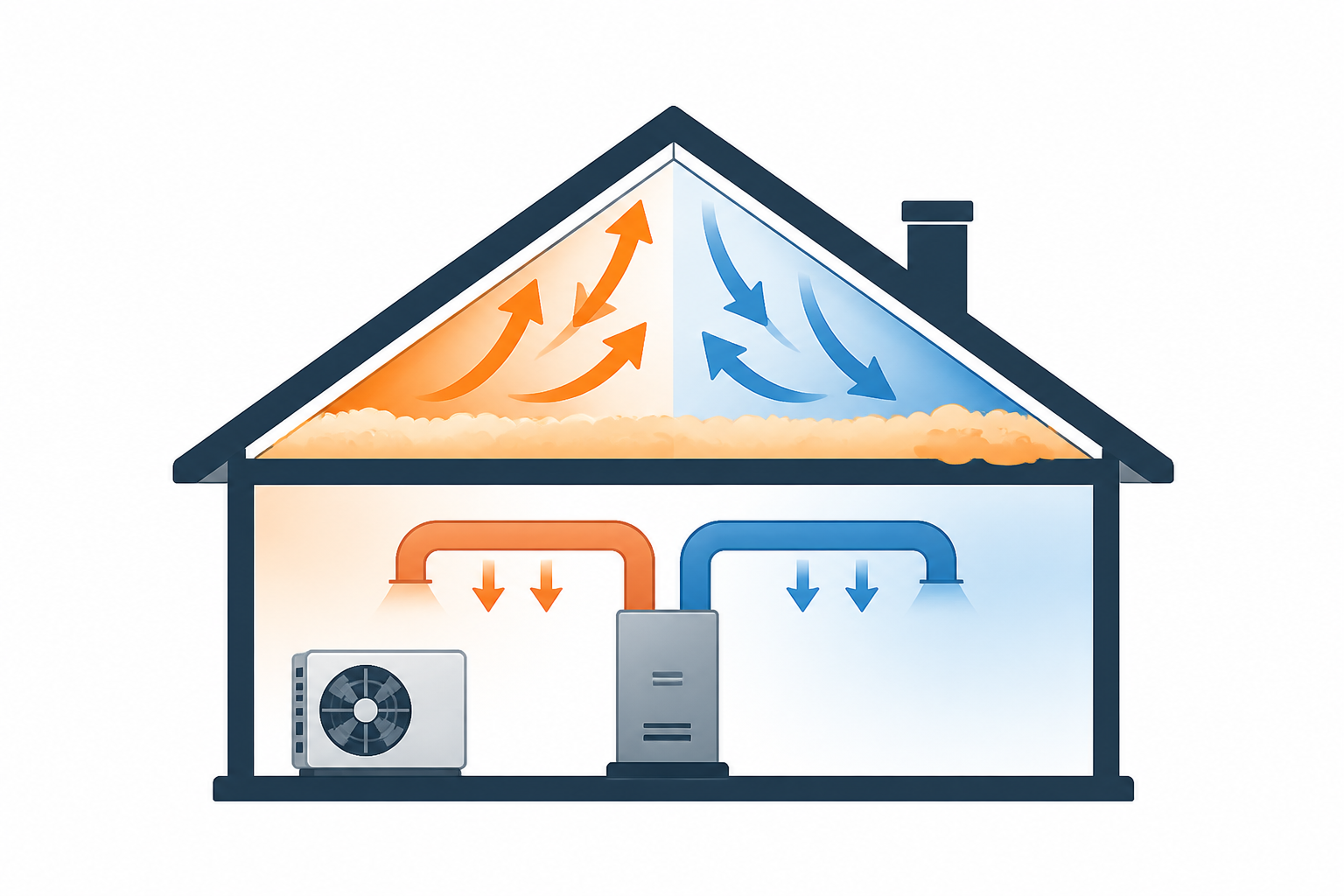
Last January, I got a call from a homeowner in northern Minnesota. His furnace had died overnight. Temperatures outside were sitting at -12°F. He’d been reading online that a heat pump could replace his gas furnace entirely — and he wanted to know if that was true. That question, right there, is the heart of the heat pump vs gas furnace cold climate debate. And honestly, the internet gives terrible answers. Half the articles are written by people who’ve never been inside a mechanical room in their lives. So let me give you my honest take — after 14 years as an HVAC technician and home performance consultant.
I’ve installed both systems. I’ve pulled apart failing heat pumps at -20°F and serviced gas furnaces pushing 30 years old. I’ve run load calculations under Manual J, argued with contractors about HSPF2 ratings, and sat at kitchen tables explaining utility bills to confused homeowners. I know what works in the real world — not just in a manufacturer’s brochure.
How Heat Pumps Actually Work in Cold Weather
Here’s the misconception I hear constantly: “Heat pumps don’t work when it’s cold outside.” That was mostly true ten years ago. It is not true today. Modern cold-climate heat pumps — specifically units rated to the NEEP (Northeast Energy Efficiency Partnerships) cold-climate standard — can operate efficiently down to -13°F or even lower. The technology changed dramatically around 2015 with variable-speed inverter compressors. These systems modulate output instead of cycling on and off. That means they extract heat from cold air more consistently and efficiently.
That said, efficiency does drop as temperatures fall. A heat pump running at 40°F might have a COP (Coefficient of Performance) of 3.5 — meaning it delivers 3.5 units of heat for every 1 unit of electricity consumed. At 5°F, that same unit might run at a COP of 1.5 to 2.0. Still efficient compared to electric resistance heat. However, when you compare it against a 96% AFUE gas furnace at those same temperatures, the math gets closer than you’d expect — especially in states where natural gas prices are high.
The key spec to look for is HSPF2 (Heating Seasonal Performance Factor, second edition). Anything above 8.5 HSPF2 is solid for a cold climate. Look for units specifically marketed as “cold-climate” or “hyper-heat” models. Those are engineered differently than standard heat pumps sold in the South.
Where Gas Furnaces Still Win the Heat Pump vs Gas Furnace Cold Climate Argument
I’ll be straight with you: in truly brutal climates — think International Falls, Minnesota or Fairbanks, Alaska — a standalone heat pump still struggles to be your primary heat source. Not because the technology is bad. The problem is economics and grid dependence. When outdoor temps drop below -15°F for days at a time, your heat pump is working hard, your electricity consumption spikes, and your utility bill follows. Gas furnaces, on the other hand, deliver consistent, high-output heat regardless of outdoor temperature.
The other factor is delivery temperature. A gas furnace typically delivers air at 120°F to 140°F from the supply registers. Many heat pumps deliver air between 90°F and 105°F at peak cold-weather operation. That difference doesn’t matter much in a well-insulated home. However, in an older house with a leaky envelope and poor insulation, that cooler supply air feels drafty. I’ve had clients call me convinced their new heat pump was broken — it wasn’t. Their house was just under-insulated.
For whole-home heating in Climate Zone 6 or 7 (as defined by ASHRAE 90.1 and the IECC), I still recommend a high-efficiency gas furnace as the primary system in most existing homes. The infrastructure is usually already in place, the fuel supply is reliable, and the upfront cost is lower than a full heat pump system with backup.
The Dual-Fuel Hybrid Approach
The smartest solution I’ve seen in cold climates is the dual-fuel hybrid system. You pair a heat pump with a gas furnace. The heat pump handles heating down to a balance point — typically around 25°F to 35°F, depending on your local utility rates. Below that threshold, the gas furnace takes over. This setup captures the efficiency of the heat pump during mild cold weather (which is most of your heating season in many northern states) while giving you the raw power of gas when you really need it. I’ve helped homeowners cut heating bills by 20–35% with this setup.
Real Numbers: Cost Comparison From My Own Clients
Let me give you real figures. One of my clients in central Wisconsin — 2,100 square foot, 1980s ranch, decent but not great insulation — was spending about $1,800 per year on natural gas heat. We installed a cold-climate mini split to handle the main living areas and kept the existing 80% AFUE furnace for backup. His gas bill dropped to around $820. His electricity bill went up about $340. Net savings: roughly $640 per year. The mini split system cost about $4,200 installed. Payback in under seven years — and he now has air conditioning in summer too, which he didn’t have before.
Another client in the same region replaced an aging furnace with a brand-new 96% AFUE two-stage unit. No heat pump involved. His annual gas bill dropped from $1,950 to about $1,390 — a $560 per year savings. The furnace cost him $3,100 installed. Payback just under six years. For that homeowner, it made sense. He was 68 years old, didn’t want to deal with two systems, and natural gas in his area was cheap.
The point is this: the right answer depends on your local utility rates, your home’s insulation level, your existing equipment, and your personal risk tolerance. In my experience, heat pumps win on efficiency math in moderate cold climates. Gas wins on simplicity and raw output in extreme cold climates. The hybrid wins almost everywhere in between.
The Product I Recommend for Cold-Climate Zone Supplemental Heat
When clients ask me for a reliable mini split for supplemental heating — or for a zone they want to prioritize for efficiency — I consistently point them toward the Senville LETO Series 12,000 BTU Mini Split Heat Pump. I’ve recommended this unit more times than I can count over the past few years, and it’s held up well for my clients.
Here’s what I like about it specifically. It runs on 110/120V — that matters because most homes don’t need to run a new 240V circuit for a single-zone application. That saves $300–$600 in electrical work right off the bat. The SEER2 rating is 20.8, which is genuinely excellent. For context, the federal minimum SEER2 in the Northern region is 13.4 as of January 2023 (per DOE regulations). This unit blows past that. The inverter-driven compressor means it modulates output efficiently rather than cycling on and off like older equipment.
The Alexa integration is a nice bonus — not something I’d buy a unit for, but clients who use it love the convenience. The unit is 1 ton (12,000 BTU), making it ideal for spaces in the 400–600 square foot range, depending on insulation quality. I’ve seen it handle a well-insulated 700 square foot open-plan living space in Wisconsin winters without breaking a sweat. For pricing and availability, check the current listing on Amazon here.
The Runner-Up: A Solid Gas Furnace Option
If you’ve decided a gas furnace is the right primary system for your cold-climate home, I’d point you toward the Goodman 96% AFUE Two-Stage 60,000 BTU Gas Furnace (Model GR9T960603BN). Goodman gets a bad reputation in some circles, but the 96% AFUE two-stage units have been reliable in my experience. The two-stage burner is important — it runs at lower capacity most of the time, which improves humidity control and comfort. The multi-speed blower helps with that too.
At 96% AFUE, nearly all the fuel you pay for becomes heat in your house. The Low NOx design also meets California’s strict emissions standards (SCAQMD Rule 1111), so it’s a responsible choice if that matters to you. At 17.5 inches wide, it fits in most standard utility closets. This is a professional installation — I’ll be clear about that. But for sourcing the equipment, the Amazon listing gives you a solid benchmark for pricing when getting contractor quotes.
What I Learned the Hard Way About Cold-Climate Heat Pumps
My biggest lesson came early in my career. I installed a standard heat pump — not a cold-climate model — for a client in northern Wisconsin. It was rated down to about 20°F on the spec sheet. The first February, it struggled badly. The supplemental electric resistance heat kicked in constantly. The client’s electricity bill spiked to nearly $400 that month. She called me furious. And she had every right to be.
I had not specified a cold-climate inverter unit. I had not done a proper Manual J heat load calculation. And I had underestimated how many hours per year her location spent below 25°F. That mistake cost me the relationship and cost her an uncomfortable winter. Since then, I pull weather data for every client’s zip code before I spec any heating system. Specifically, I look at design temperature (the 99th percentile outdoor temperature from ASHRAE data) and hours below 20°F annually. Those two numbers tell me more than any marketing spec sheet.
Do not skip the Manual J load calculation. Any contractor who quotes you a system size without running one is guessing. An oversized furnace short-cycles and wastes fuel. An undersized heat pump fails to keep up on the coldest days. Both outcomes are avoidable with a proper load calculation — which typically costs $150–$300 as a standalone service.
When to Call a Pro (And When You Shouldn’t DIY This)
I’m going to be honest here. Gas furnace installation is not a DIY job in most jurisdictions. Working with gas lines requires a licensed contractor and a permit in virtually every state. Gas connections that fail can cause carbon monoxide poisoning or fire. That is not a risk worth taking to save a few hundred dollars on labor. Hire a licensed HVAC contractor, pull the permit, and get the work inspected.
Mini split heat pumps are more nuanced. Some units — including the Senville LETO — are designed as DIY-friendly with pre-charged line sets. However, line set installation, wall penetration, and electrical work still require care. In most states, connecting refrigerant lines on systems that need field charging requires EPA 608 certification. The 110V plug-in models reduce the electrical complexity, but local codes still govern what’s required. Always check with your local building department before starting.
Call a pro for: Manual J load calculations, gas line work, permit filing, electrical panel upgrades, refrigerant handling, and any ducted system installation. Consider DIY for: basic thermostat replacement, filter changes, cleaning coils on accessible systems, and smart control upgrades.
Final Thoughts on Heat Pump vs Gas Furnace in Cold Climates
Here’s my bottom line on the heat pump vs gas furnace cold climate question: there is no universal answer, but there is a logical framework. If you’re in Climate Zone 4 or 5 and your local electricity rates are reasonable, a cold-climate heat pump as your primary system is a smart, efficient choice. If you’re in Climate Zone 6 or 7 with natural gas access, a high-efficiency gas furnace paired with a mini split for supplemental zoning is likely your best bet. The dual-fuel hybrid beats both for homeowners who want maximum efficiency without sacrificing comfort on the coldest nights.
What I’d tell every homeowner before making this decision: get your home’s insulation and air sealing right first. No heating system performs as designed in a leaky, under-insulated house. I’ve seen $6,000 heat pump installs disappoint because the attic had 4 inches of old fiberglass and the rim joists were completely open. Fix the envelope, then optimize the system. In that order. Always.
For supplemental zone heating, I stand behind the Senville LETO 12,000 BTU Mini Split as a practical, efficient, and reasonably priced option. For a new primary gas furnace, the Goodman 96% AFUE two-stage unit is a solid workhorse. Either way, don’t let anyone sell you a system without doing the math for your specific home, your climate, and your utility rates first.
This post contains affiliate links. As an Amazon Associate, I earn from qualifying purchases at no extra cost to you.