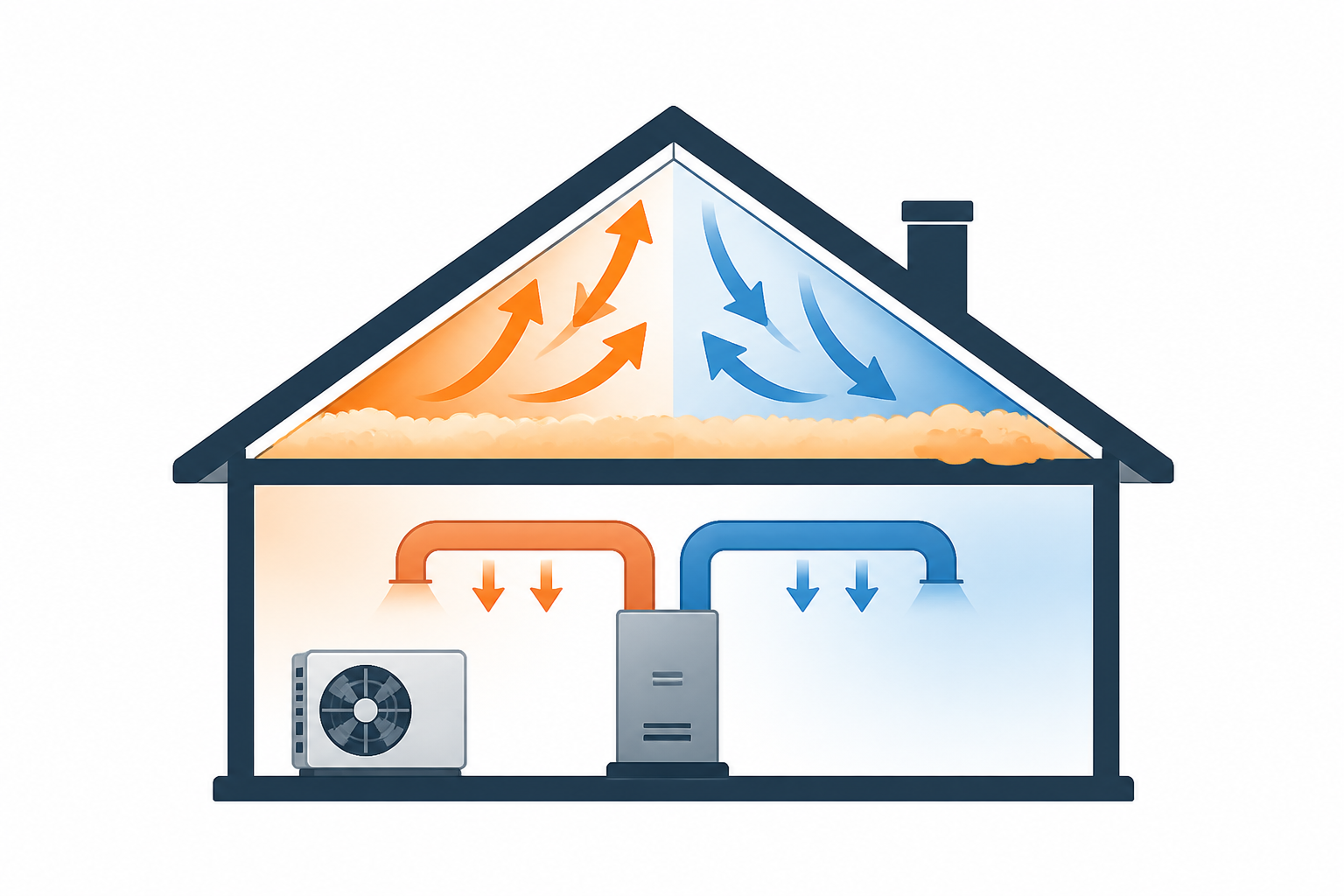
Every summer, I get the same call. A homeowner tells me one bedroom stays 10 degrees hotter than the rest of the house — no matter what they set the thermostat to. They’ve already changed their air filter. They’ve already called their HVAC company once. Sometimes twice. And they’re still sweating. If you’re searching for a one room always hot HVAC fix, I want to tell you something upfront: the problem almost certainly isn’t your equipment. It’s your ductwork pressure. Specifically, it’s something called static pressure imbalance — and it’s one of the most misdiagnosed comfort complaints in residential HVAC.
I’ve been doing this work for over a decade. In that time, I’ve diagnosed hundreds of hot-room complaints. The vast majority trace back to the same root cause: the duct system is fighting itself. Air is supposed to flow freely from your air handler to every room. However, when restrictions, undersized ducts, or poor design choke that flow, some rooms get plenty of conditioned air — and others get almost none.
This post is going to explain what static pressure actually is, how to check it yourself, and what your real options are — including one product I’ve personally installed that solves this problem surprisingly well. Let’s get into it.
What Static Pressure Actually Means (And Why It Matters)
Static pressure is the resistance your blower motor fights against to push air through the duct system. Think of it like water pressure in a hose. When the hose is clear and open, water flows easily. Pinch the hose, and flow drops dramatically — even though the pump is working just as hard.
HVAC systems are designed to operate within a specific static pressure range. Most residential systems are rated for a maximum of 0.5 inches of water column (IWC) of total external static pressure. ACCA Manual D — the industry standard for duct design — establishes these parameters. When your system runs above that threshold, airflow to distant or restricted rooms drops sharply.
In my experience, most systems I measure in the field run between 0.7 and 1.0 IWC. That’s 40 to 100 percent over design. The blower works harder, runs hotter, and still can’t push enough air to the bedroom at the end of the hall. That bedroom stays hot. Your energy bill goes up. And everyone assumes the AC is undersized. It usually isn’t.
The Most Common Causes of High Static Pressure
Before you fix anything, you need to know what’s causing the restriction. In my experience, it usually comes down to one of five culprits.
- Undersized return air grilles: The most common issue I find. Most builders install one return grille per floor. That’s almost never enough.
- Dirty or high-MERV filters: A MERV 13 filter in a system designed for MERV 8 can add 0.2 to 0.3 IWC of restriction on its own.
- Kinked or crushed flex duct: Flex duct that bends more than 90 degrees can lose up to 50 percent of its carrying capacity.
- Closed or partially closed dampers: Sometimes manual dampers in the trunk line get adjusted and forgotten. I’ve found them fully closed in homes where the owners had no idea they existed.
- Undersized duct branches: A 4-inch round duct serving a 200-square-foot room is simply too small. Period.
Last spring, I had a client whose master bedroom was consistently 12°F hotter than the rest of the house. We pulled the flex duct from the ceiling and found a 90-degree bend that had kinked completely shut over years of sagging. The duct looked fine from the grille. However, three feet inside the ceiling, airflow was essentially zero. A simple re-route fixed 80 percent of the problem in under two hours.
How to Diagnose the Problem Yourself
You don’t need to be an HVAC tech to gather useful data. A manometer — a digital differential pressure gauge — tells you exactly what’s happening inside your duct system. I learned this the hard way early in my career. I spent three visits troubleshooting a hot room by guessing. Once I started carrying a manometer on every call, diagnosis time dropped by more than half.
Using a Manometer to Find the Problem
For homeowners who want to dig in themselves, I recommend the EHDIS Dual-Port Digital Manometer. It’s a professional-grade tool at a price point that makes sense for a serious DIYer — typically under $40. It reads in inches of water column, pascals, and several other units. That matters when you’re cross-referencing ACCA standards.
Here’s how to take a basic static pressure reading. First, drill a small test hole in the supply plenum, downstream of the air handler. Then drill another in the return plenum, upstream of the filter. Connect each port to the manometer using the included tubing. Run the system and record both readings. Add them together — that’s your total external static pressure.
If your combined reading exceeds 0.5 IWC, you have a high static pressure problem. Above 0.8 IWC, I consider it severe. At that level, rooms at the end of long duct runs will almost always underperform. The manometer won’t fix your system — but it tells you exactly what you’re dealing with before you spend money on solutions.
Room-by-Room Airflow Checks
While you’re at it, do a simple airflow check at each supply grille. Hold a tissue or lightweight piece of paper near the grille with the system running. Strong, consistent pull means good airflow. Weak flutter means restricted flow. This isn’t a precise measurement — but it quickly identifies which rooms are starved for air.
For more precision, an anemometer (air velocity meter) paired with the grille’s square footage gives you actual CFM. A 200-square-foot bedroom typically needs 50 to 75 CFM of supply airflow to maintain comfort. If you’re measuring 20 CFM, no thermostat setting in the world will fix that room.
The One Room Always Hot HVAC Fix That Actually Works
Once you’ve confirmed the problem is airflow to a specific room, you have a few options. Re-routing or upsizing the duct branch is the gold-standard fix. That typically costs $300 to $800 depending on accessibility and duct length. Adding a return air grille near the problem room costs $150 to $400 installed. Both are excellent long-term solutions.
However, sometimes duct work access is genuinely brutal. Finished ceilings, tight attic spaces, or a single room in a second-story addition — these situations make full duct replacement a $1,500 to $3,000 project. That’s when I recommend a duct booster fan as a targeted, cost-effective fix.
My Go-To Recommendation: The Tjernlund DB-2 Duct Booster
I’ve installed several inline duct booster fans over the years. Most of them disappointed me. They were loud, ineffective, or both. The Tjernlund DB-2 Duct Booster Fan is genuinely different. I first used one about four years ago on a second-story bedroom that had driven two families crazy in the same house. The duct run was 38 feet of 6-inch flex with two bends. Replacing it wasn’t feasible without tearing out a finished ceiling.
The DB-2 moves 275 CFM — that’s serious airflow for an inline unit. It installs directly into the existing duct run and is compatible with standard 6-inch round duct. Installation took me about 45 minutes, including running a switched 120V circuit to the unit. The motor is quiet enough that you can’t hear it from the room itself. Specifically, this unit is UL listed, which matters if you’re pulling permits or just care about electrical safety.
After installing the DB-2 in that second-story bedroom, the room went from being 11°F over the rest of the house to within 2°F. The homeowner called me a week later to say it was the first summer in four years they’d actually slept comfortably up there. That result isn’t unusual. As a result, this fan is now my first recommendation when the duct run is long, access is limited, and the rest of the system checks out.
One honest note: a duct booster fan works best when the duct itself is intact and sized reasonably. If your duct branch is a 4-inch round serving a large room, the booster won’t fully compensate. For that situation, upsizing the duct is non-negotiable. However, for a 6-inch or larger run with adequate duct size but poor pressure balance, the Tjernlund DB-2 is a legitimate, lasting fix.
Other Fixes Worth Considering Before You Call a Contractor
Not every hot room problem requires a product purchase or a contractor visit. Before spending a dollar, check these three things first.
- Drop your filter MERV rating. Swap a MERV 13 for a MERV 8 and retest airflow. If the hot room improves, your system can’t handle high-restriction filtration. This is a free fix that works more often than you’d think.
- Open all supply registers fully. Closing registers in unused rooms does not redirect air to problem rooms. It raises static pressure system-wide and makes things worse everywhere. Open them all.
- Check for and straighten kinked flex duct. If you have attic access, visually inspect every flex duct run to the problem room. A kinked section is a 30-minute fix with a couple of zip ties and metal duct tape (not regular duct tape — use foil-backed tape rated for HVAC).
These steps won’t fix everything. However, they cost nothing and eliminate the easiest causes before you invest in equipment or labor.
When to Call a Pro — Honest Advice
I’m all for homeowner diagnostics. That said, there are situations where calling a licensed HVAC contractor is the right move — not because the work is dangerous, but because the problem requires tools and knowledge that go beyond a weekend project.
Call a pro if your total static pressure measures above 0.8 IWC and your filter is already clean and correctly sized. At that level, the problem is likely systemic — undersized return, poorly designed trunk line, or an air handler that’s simply mismatched to the duct system. These require a Manual D analysis and possibly significant duct redesign.
Also call a pro if the hot room problem is in a newer home under five years old. Modern construction often qualifies for blower door and duct leakage testing requirements under IECC 2018 or your local energy code. A contractor can perform a duct leakage test (reported as CFM25 or CFM50) and identify whether duct leakage is the culprit rather than restriction. Leaky ducts in unconditioned attics are a serious efficiency and comfort issue — and they’re not something a duct booster will solve.
Finally, if you suspect the issue is refrigerant charge or a failing compressor, stop troubleshooting ductwork and call immediately. A refrigerant leak requires EPA Section 608 certification to handle legally. That’s not a DIY scenario under any circumstances.
Final Thoughts
If one room in your home is always hotter than the rest, the answer is almost never “buy a bigger AC unit.” In my decade-plus of field experience, the real one room always hot HVAC fix is almost always about airflow — and airflow problems come from static pressure imbalance, kinked ducts, undersized returns, or restrictive filters.
Start with the free fixes: open your registers, drop to a lower MERV filter, and inspect your flex duct for kinks. Grab a manometer like the EHDIS Digital Manometer if you want real data before spending money. And if the duct run is long, accessible, and properly sized, the Tjernlund DB-2 Duct Booster is the most effective inline fan I’ve personally used — and it’ll likely be the last thing you need to buy.
You deserve to be comfortable in every room of your home. With the right diagnosis and the right fix, that’s completely achievable — without replacing a perfectly good HVAC system.
This post contains affiliate links. As an Amazon Associate, I earn from qualifying purchases at no extra cost to you.