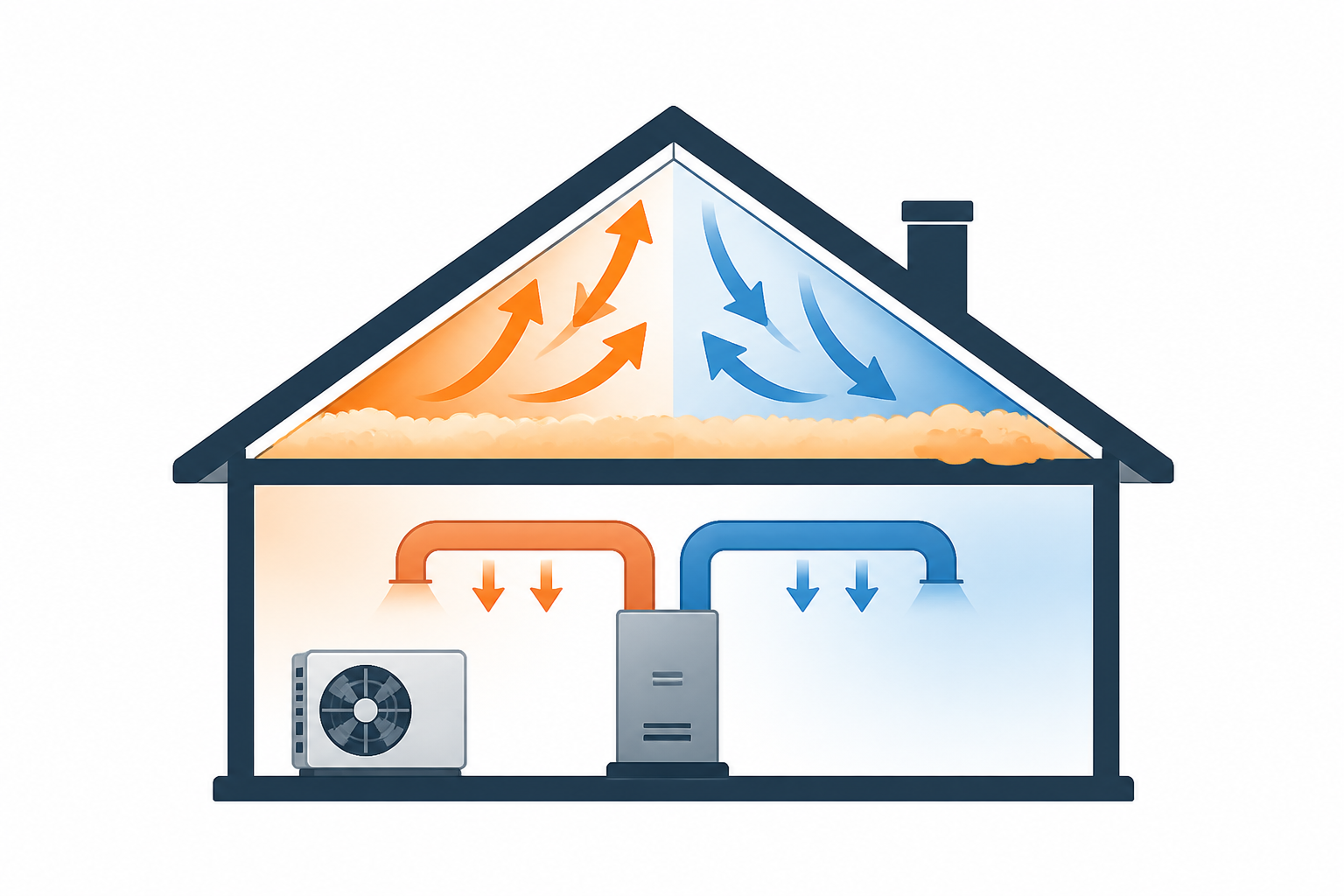
Last fall, I climbed into a client’s attic in suburban Salt Lake City and found something I’ve seen dozens of times — beautiful, fluffy R-38 fiberglass batts covering every square inch of the attic floor. The homeowner was proud of it. He’d paid a contractor $1,800 to have it installed three years ago. His heating bills hadn’t budged. Here’s what nobody told him: an attic air leak bypasses insulation entirely, and his attic had at least a dozen of them. The insulation was essentially decorative.
This is the most common and most expensive mistake I see in home performance work. Homeowners — and frankly, some contractors — treat insulation as the solution to heat loss. It isn’t. Insulation slows conductive heat transfer. Air sealing stops convective heat loss. You need both. Without air sealing first, adding more insulation is like putting a thicker blanket over a window you left cracked open.
In this post, I’m going to walk you through exactly where these leaks hide, why they matter so much, and how to fix them yourself for under $100 in most cases. I’ve spent thousands of hours in attics across Utah, Nevada, and Idaho. This is what I know.
Why an Attic Air Leak Bypasses Insulation — And Your Wallet
Here’s the physics in plain language. Insulation works by trapping air in small pockets. Those pockets resist heat moving through solid material — that’s conduction. However, when warm indoor air finds a gap in your ceiling and flows directly into your cold attic, it carries heat with it instantly. No insulation layer can stop that. The air simply goes around it.
Building scientists call this “stack effect.” Warm air rises inside your home, pressurizes the upper floors, and pushes out through every gap it can find. In winter, that means your heated air is constantly escaping into the attic. Your furnace runs longer to replace it. According to the Department of Energy, air leakage accounts for 25–40% of heating and cooling energy loss in a typical American home. Most of that leakage is at the attic plane.
I’ve run blower door tests on homes with R-49 attic insulation that still tested at 8 ACH50 or higher — that’s a leaky house by any standard. In contrast, I’ve tested homes with modest R-30 insulation and solid air sealing that hit 3 ACH50. The well-sealed home was dramatically more efficient. Air sealing first, insulation second. That’s the correct order of operations under ASHRAE 62.2 and energy code in most jurisdictions.
The Five Bypasses Hiding Under Your Insulation Right Now
Pull back your attic insulation in a few spots and you’ll likely find these. I find them in almost every house I inspect, regardless of age or construction quality.
1. Top Plates of Interior Walls
This is the big one. Every interior wall in your house has a top plate — usually a doubled 2×4 — sitting right at the attic floor. The drywall below rarely seals against it perfectly. Air travels up through wall cavities and straight into the attic through these gaps. On a 2,000 square foot home, I typically find 40–60 linear feet of unsealed top plates. That adds up to a significant hole.
2. Recessed Light Cans
Old-style recessed lights (ICAT or non-ICAT) are essentially holes punched through your ceiling. Each one can lose as much conditioned air as a softball-sized opening. I once counted 22 recessed cans in a single ranch-style home. The homeowner’s heating bills in January were over $340/month. After sealing and insulating those cans with fire-rated covers, her bills dropped to under $210. That’s $130 a month — real money.
3. Plumbing and Electrical Penetrations
Every pipe, wire, and duct that passes through your ceiling plane is a potential bypass. Plumbers and electricians aren’t air sealers — they don’t fill those gaps. Specifically, look around bathroom exhaust fans, plumbing vent stacks, and electrical junction boxes. Each gap might only be a quarter-inch wide. However, multiplied across an entire house, they represent a significant cumulative opening.
4. Dropped Soffits and Chases
Kitchen soffits, stairwell chases, and HVAC chases are notorious bypasses. They create a direct thermal highway from your living space to the attic. I’ve seen kitchen soffits with openings 8–10 inches wide running several feet long. These are covered with insulation and completely invisible until you go looking. Air sealing these requires rigid foam board and fire-rated foam — not just a bead of caulk.
5. Attic Hatch or Pull-Down Stairs
Most attic hatches are thin, uninsulated pieces of drywall or wood. Pull-down stair assemblies are even worse — they’re essentially a large hole with a ladder attached. I’ve measured temperature differentials of 20°F between the hatch frame and the surrounding ceiling in winter. Weatherstripping and an insulated cover box can solve this quickly. It’s often the highest-return upgrade in the entire attic.
How to Actually Fix These Leaks: My Field-Tested Process
Before you do anything, gear up properly. You’ll need an N95 respirator rated for particulates, safety glasses, knee pads, a headlamp, and disposable coveralls. Attic insulation — especially older fiberglass or cellulose — is miserable to breathe. I learned this the hard way on my third attic job when I wore just a dust mask and spent two days coughing. Never again.
Here’s the sequence I follow on every air sealing job:
- Pull back or temporarily move insulation to expose the attic floor and top plates.
- Use a headlamp to locate every penetration, gap, and open cavity.
- Seal small gaps (under ½ inch) with caulk or fire-rated foam.
- Cover large openings (over ½ inch) with rigid foam board cut to fit, then foam the edges.
- Re-install or add insulation only after air sealing is complete.
That fifth step is non-negotiable. Air sealing first, always. Insulating over unsealed bypasses is exactly the mistake I described at the top of this post.
The Product I Trust for Fire-Rated Attic Air Sealing
Here’s where material choice really matters. Around recessed lights, top plates, and any penetration near heat sources, you cannot use standard expanding foam. You need a fire-rated product. The International Residential Code (IRC) Section R302.13 requires fire blocking at concealed draft openings in attics. Standard foam does not meet that requirement.
The product I reach for consistently is the 3M Fire Block Foam FB-Foam. It’s orange — which matters more than you’d think. The color makes it easy to see where you’ve applied it in dark attic conditions. More importantly, it meets ASTM E84 flame spread requirements and is specifically designed for sealing penetrations in fire-resistance-rated assemblies.
I’ve used this foam on over 150 attic air sealing jobs. It expands predictably, cures in about 8 hours, and doesn’t require any mixing or special equipment. One 12 fl oz can covers roughly 40–50 small-to-medium penetrations when used efficiently. For a typical 1,500–2,000 sq ft home, I usually go through 3–4 cans in a thorough air sealing session. At roughly $15–18 per can, that’s $45–70 in materials for potentially hundreds of dollars in annual energy savings.
The straw applicator that comes with it is reliable and gives you good control in tight spaces around wiring and pipes. That said, I always keep a spare straw in my bag — they occasionally clog if foam starts to cure inside. That’s a minor gripe on an otherwise excellent product.
Budget-Friendly Alternative
If you’re working on a larger project and want to stretch your budget, the Kraken Bond Extreme Orange Fire Block Foam is a solid runner-up. It comes in a two-pack of 24 oz cans — giving you significantly more volume per dollar. The expansion rate is higher than the 3M product, so use it carefully around small gaps where over-expansion could cause issues. For large open chases or dropped soffits, however, it performs very well. It’s fire-rated polyurethane and works fine for most residential air sealing applications.
What a DIY Attic Air Sealing Project Actually Costs and Takes
Let me give you real numbers from real jobs. A thorough DIY air sealing project on a 1,800 sq ft single-story home typically takes 4–6 hours of attic time, spread across one or two days. Material costs usually run $80–$150, depending on how many large bypasses you find. That includes foam, rigid foam board for soffit covers, and foil tape.
In my experience, homeowners who complete a proper air seal before adding insulation see 15–25% reductions in heating and cooling costs. On a $2,400/year energy bill, that’s $360–$600 in annual savings. Payback period is typically under six months. No other single home improvement comes close to that return on investment.
Compare that to hiring a professional air sealing contractor. In my market, labor alone runs $600–$1,200 for a standard attic job, plus materials. That’s not unreasonable for the work involved — but it’s well within reach for a capable DIYer with a free weekend and the right materials.
When to Call a Pro Instead of DIYing This
I’m a strong advocate for DIY air sealing, but there are situations where you need a professional. Here’s my honest list:
- You find knob-and-tube wiring. Do not insulate over it — it’s a fire hazard. Call an electrician before proceeding with any attic work.
- You see signs of moisture damage or mold. Air sealing over a moisture problem traps it. A building performance contractor needs to diagnose the source first.
- Your attic has vermiculite insulation. It may contain asbestos. Don’t disturb it. Call a certified abatement contractor immediately.
- You want a verified result. A blower door test before and after gives you hard data on your improvements. Most energy auditors charge $300–$500 for a full audit including the test. Worth it for larger homes.
- Your attic is physically inaccessible. Low-slope roofs with under 18 inches of clearance are not safe for DIY work. Professionals have specialized equipment for these situations.
Being honest here: I’ve seen DIYers make attic problems worse by sealing in moisture or covering hazardous materials. If anything seems off when you get up there — unusual smells, visible staining, discolored insulation — stop and get a professional opinion before proceeding.
Final Thoughts: Seal First, Insulate Second — Every Time
The core truth of this whole post is simple. An attic air leak bypasses insulation completely, and no amount of R-value compensates for unsealed bypasses underneath. I’ve seen this mistake cost homeowners thousands of dollars over years of inflated energy bills — all because someone skipped the air sealing step and went straight to laying batts.
The fix is not complicated. It takes a free Saturday, less than $150 in materials, and a willingness to spend a few hours in an uncomfortable space. The payback is fast — often under a year. More importantly, your home actually performs the way you expect it to.
Start with the five bypass locations I outlined above. Use fire-rated foam — the 3M Fire Block Foam is what I use and recommend without hesitation. Seal everything before you touch the insulation. Then add your insulation on top of a properly sealed surface, and you’ll finally get the performance you’ve been paying for.
If you have questions about your specific attic situation, drop them in the comments below. I read every one.
— Dana Sorensen, HVAC Technician & Home Performance Consultant
This post contains affiliate links. As an Amazon Associate, I earn from qualifying purchases at no extra cost to you.